Quick answer
A good cutting board setup comes down to four things: a material that is easy to keep clean and kind to your knives, separate surfaces for raw meat and for produce, a proper wash after every use, and replacing a board once it is grooved, cracked or smelly. This guide maps each of those topics in a few lines and links the in-depth article for each one. For the board we recommend, read our Katori titanium cutting board review.
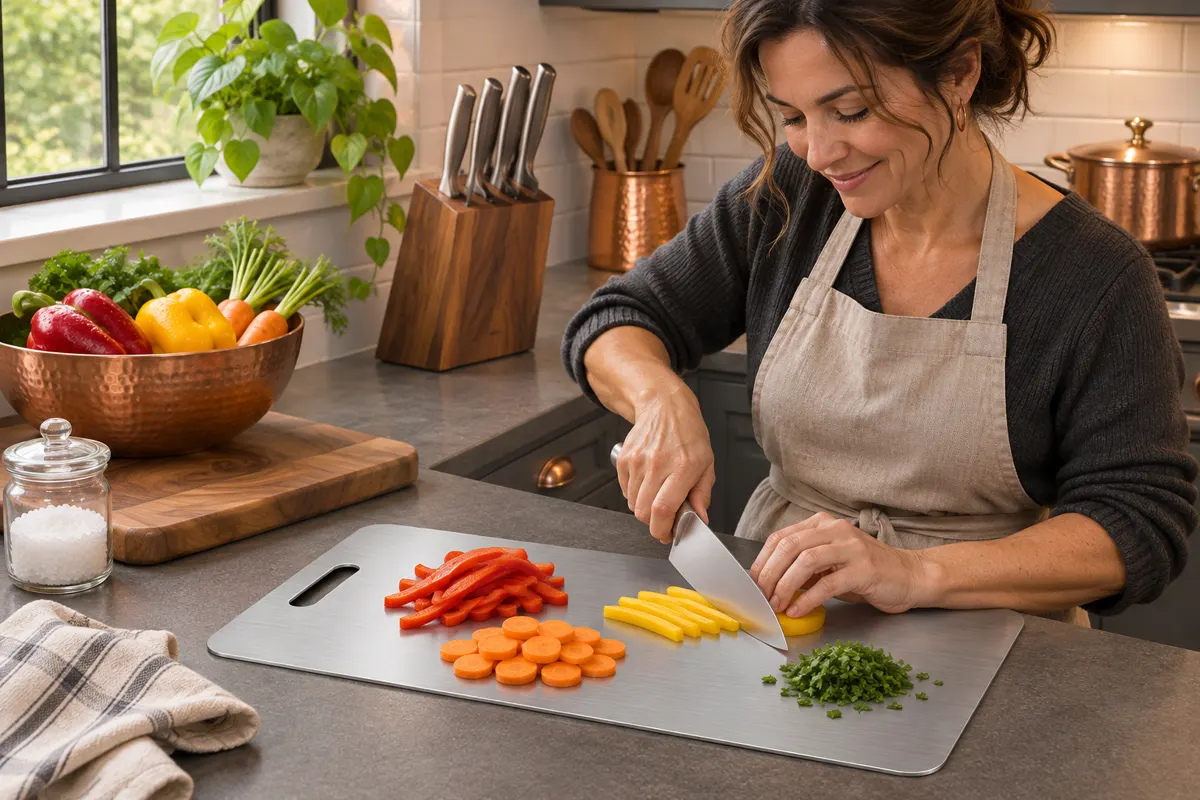
Most people buy a cutting board once, use it for years and never think about it again until it warps, smells or cracks. Yet that board touches almost everything you eat: raw chicken on Tuesday, salad on Wednesday, bread on Sunday. Over the past weeks we have written a detailed guide for nearly every question about cutting boards. This page is the map that connects them, so you can find the answer you need in a minute and dig deeper only where it matters to you.
1. Choosing a material
Every material is a trade-off between hygiene, knife care, weight and upkeep. Wood is warm and gentle on knives but needs oiling and hand washing. Plastic is light and cheap but scars quickly and those scars hold food. Glass and stone are easy to wipe but hard on edges. Steel and titanium are non-porous and dishwasher-friendly. Our comparison of wood vs. plastic vs. titanium walks through each one, and the stainless steel cutting board pros and cons explain how the two metals differ.
| Material | Easy to keep clean | Kind to knives | Upkeep |
|---|---|---|---|
| Wood / bamboo | Fair (porous) | Good | Hand wash, regular oiling |
| Plastic | Good when new, poor once grooved | Good | Replace when scarred |
| Glass / stone | Good | Poor | Low, but chips |
| Titanium | Very good (non-porous) | Good with a slicing stroke | Low, dishwasher-safe |
If you are shopping for a metal board, read pure titanium vs. titanium-coated first, and if the jargon on product pages confuses you, our glossary of 12 cutting board terms decodes it.
2. Food safety: separate boards and cross-contamination
Food-safety agencies keep the rule simple: one surface for raw meat, poultry and seafood, another for produce and ready-to-eat food. Our 10 cutting board rules to avoid cross-contamination apply to any big cooking day, and if it already happened, used the same board for raw chicken and vegetables? tells you what to do right now. For questions about the material itself, see are titanium cutting boards safe?
3. Cleaning after raw meat and the dishwasher question
Scrape, wash with hot soapy water, rinse, dry. To sanitize, the USDA suggests about 1 tablespoon of unscented liquid chlorine bleach per gallon of water. Our step-by-step on how to clean a cutting board after raw meat covers every material, and can you put a cutting board in the dishwasher? explains why wood and bamboo should stay out while plastic and metal can go in.
4. Smells and stains
Garlic, onion, fish and turmeric leave their mark on porous boards. Baking soda, lemon and salt help, but the real fix is a surface that does not absorb in the first place. Our guide to getting rid of smells and stains on a cutting board has a method for each one.
5. Your knives and your board
The board decides how often you sharpen. Very hard surfaces like glass and stone dull an edge in days; softer and well-designed surfaces keep it longer, especially with a gliding slicing stroke. Read how to keep your kitchen knives sharp for the basics and do titanium cutting boards dull knives? for honest answers about metal boards.
6. How many boards you need
Two is the minimum for food safety; three or four make busy days and meal prep easier. Our guide to how many cutting boards you need describes the normal home setup, and the 1-hour Sunday chopping routine shows that setup at work.
7. When to replace a cutting board
Deep grooves, cracks, warping and smells that no longer wash out are the signs a board can no longer be cleaned properly. The USDA advises replacing boards with hard-to-clean grooves. Our checklist of 7 signs it is time to replace your cutting board helps you decide, and titanium cutting board pros and cons over 12 months shows what a long-lasting board looks like over time.
8. Microplastics and the plastic question
Every knife stroke on a plastic board can scrape off tiny particles, and researchers have estimated that plastic boards can release them into food. Read are your plastic cutting boards putting microplastics in your food? for what the research says, and a realistic 30-day plan to reduce microplastics in your kitchen for one easy swap per week.
Our recommendation: the Katori titanium cutting board
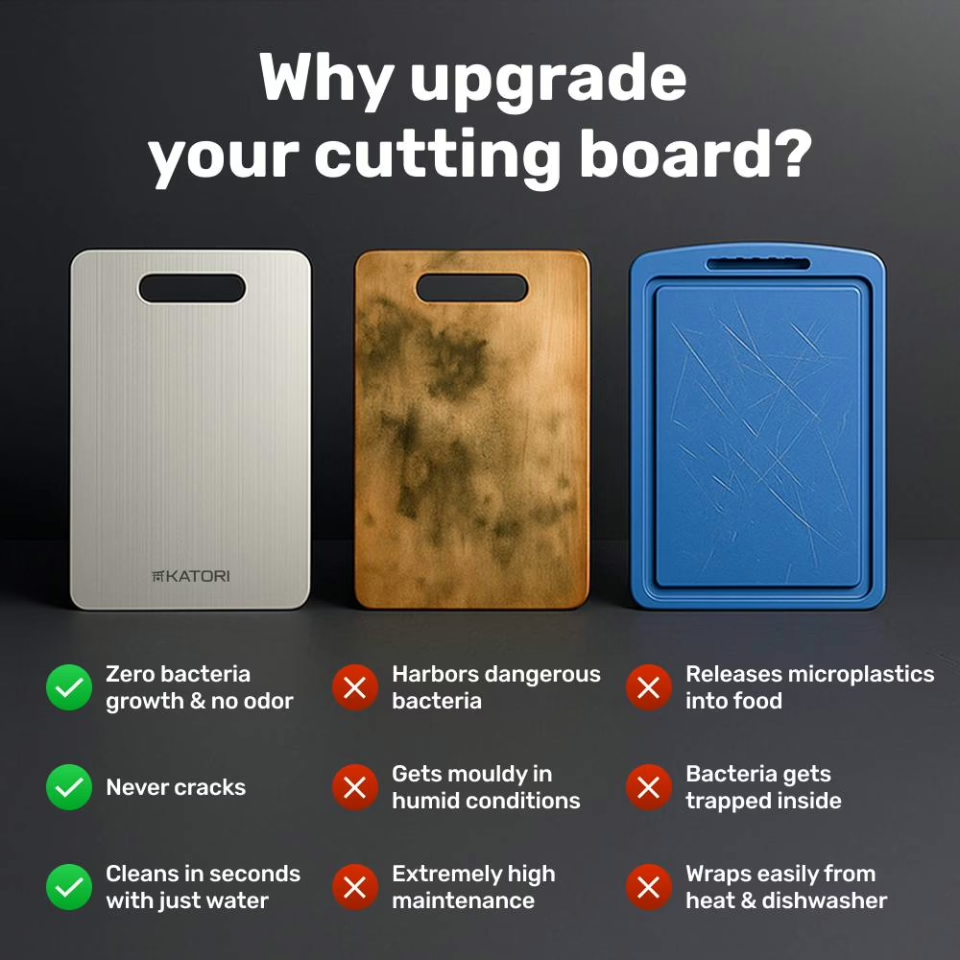
Put the eight sections together and one board answers almost all of them at once: the Katori titanium cutting board. It is non-porous, so juices, smells and stains wash off instead of soaking in; it is double-sided, so one face can stay for raw meat and the other for produce; it goes in the dishwasher; it does not shed microplastics; and, according to the maker, it is designed to be gentle on your knives. It is the simplest way to replace a tired plastic or wooden board with one that is easy to keep clean for years.
- 100% titanium, per the maker: no coating to wear through and no plastic side.
- Laser-cut, double-sided surface: one face for raw meat and one for produce.
- Non-porous: juices, smells and stains stay on the surface and wash away.
- Zero microplastics: nothing shed into your food.
- Dishwasher-proof: no warping, cracking or oiling. Size 11.4" x 7.9".
- 30-day money-back guarantee: refund or exchange, with 24/7 support from the official store.
On the official store a single board is currently $59.00 (50% off), the 2-board set is $99.98, three boards are $137.85 and four are $143.60. Shipping is calculated at checkout. The board is rated 4.7/5 by more than 1,894 reviewers.
Cutting board guide: FAQ
What is the most hygienic cutting board material?
Non-porous surfaces are the easiest to keep clean, because juices and bacteria stay on the surface where washing can reach them. The USDA notes that boards with deep knife grooves become hard to clean and should be replaced. A solid metal board such as titanium does not develop those grooves the way plastic does and does not shed plastic particles.
How should I clean a cutting board after raw meat?
Scrape off food, wash with hot soapy water, rinse and dry. To sanitize, the USDA suggests about 1 tablespoon of unscented liquid chlorine bleach per gallon of water, left on the surface for a few minutes and then rinsed. Dishwasher-safe boards can also go through a hot dishwasher cycle.
How many cutting boards should a home kitchen have?
At least two: one only for raw meat, poultry and seafood and one for produce and ready-to-eat food, as food-safety agencies recommend. A double-sided board can cover both jobs if you keep one face for raw meat and one for everything else.
When should I replace a cutting board?
Replace a board when it has deep grooves or cuts you cannot clean, cracks, warping, stains or smells that no longer wash out, or, for plastic, a fuzzy, shredded surface. Those are the signs that it can no longer be cleaned properly.
Do cutting boards affect knife sharpness?
Yes. Glass, stone and ceramic boards are very hard and dull edges quickly. Wood and plastic are gentler. With a firm board such as titanium, a gliding slicing stroke and regular honing keep edges in good shape; the maker says the Katori board is designed to be gentle on knives.
Want to keep learning? Read what Katori is, explained in 3 levels, head back to the Katori overview or read our hands-on Katori review.