Quick answer
Katori is a cutting board made of solid titanium instead of plastic or wood: a thin, non-porous, double-sided metal board that does not shed microplastics, washes clean in the dishwasher and, according to the maker, is designed to be gentle on your knives. That is Level 1. Level 2 adds what you need to decide; Level 3 explains why it works. For our hands-on verdict, read the full Katori review.
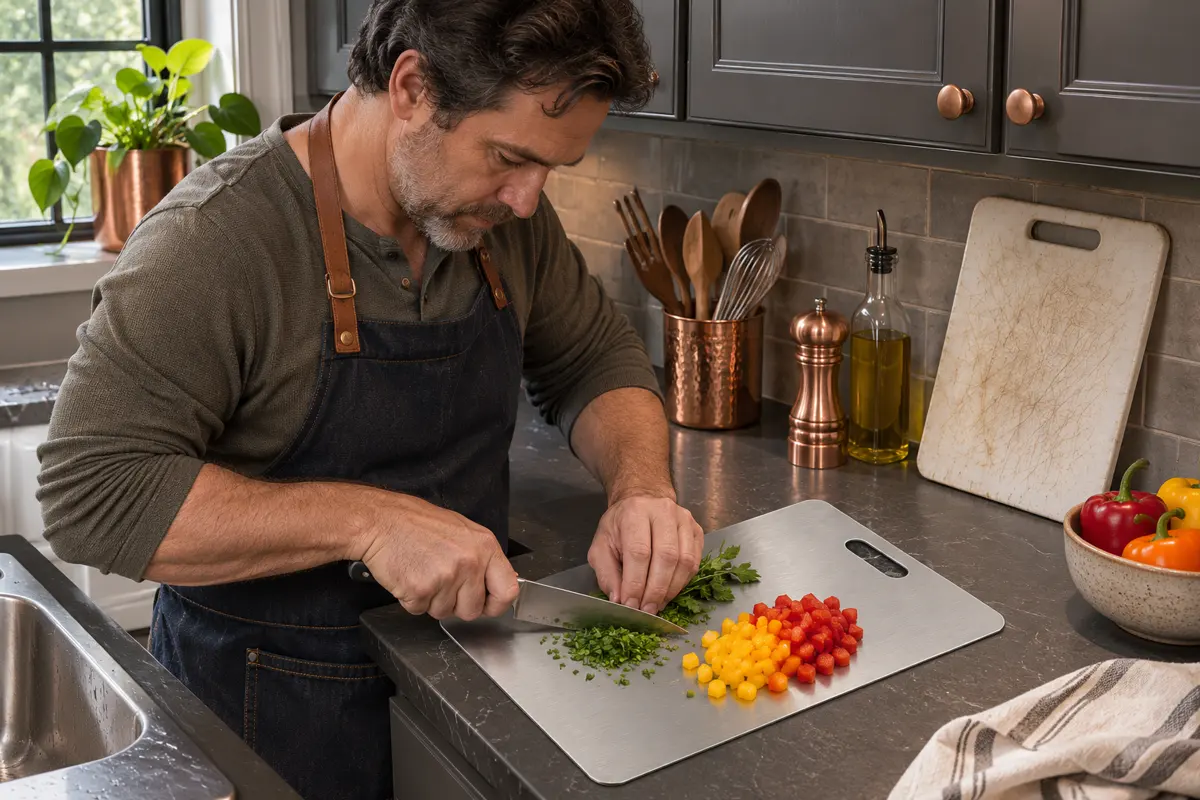
“Katori” is a name more and more home cooks are typing into Google, often with a simple question attached: what is it? Some have seen an ad, some have heard a friend mention a “metal cutting board,” some want to know whether it is a brand, a material or a gimmick. Different readers want different depths, so we answered the question three times. Each level is complete on its own, and none of them requires the others.
Level 1: the one-sentence answer
Katori is a titanium cutting board: a metal board that replaces your plastic or wooden one, so nothing soaks in, nothing sheds into your food and it goes in the dishwasher.
If that is all you wanted to know, you can stop here.
Level 2: the one-paragraph answer
The Katori Titanium Cutting Board is a thin, rectangular board that, according to the maker, is made of 100% titanium, with no coating and no plastic layer. It measures 11.4 by 7.9 inches, has a laser-cut, double-sided surface (one side for raw meat, one for produce) and a handle cut-out. Because metal is non-porous, juices, garlic smells and stains stay on the surface and wash away, and because it is not plastic, it does not release microplastics as your knife scores it. It is dishwasher-safe and does not warp, crack or need oiling like wood. The maker says it was created by Kaito Mason, a culinary coach with two decades as a chef in Japanese cuisine, to stop people choosing between a hygienic board and a knife-friendly one. It is sold through the official store, from $59 for one board, with a 30-day money-back guarantee.
Level 3: the complete answer
The material: what titanium is and why it suits food prep
Titanium is a lightweight, very strong metal best known from aircraft parts, watch cases and medical implants. Two properties matter in a kitchen. First, it is highly corrosion-resistant: in air it instantly forms a thin, stable oxide layer on its surface that protects it from rust, acids and salt water. Second, it is considered biocompatible, which is why surgeons use it inside the human body. For a cutting board, that combination means a surface that does not rust, does not react with lemon juice or tomatoes and does not need a protective oil or coating. If you want the food-safety details, our guide are titanium cutting boards safe? covers food contact and heat.
Pure titanium vs. “titanium” boards
Not every board sold as “titanium” is solid titanium. Many lookalikes are stainless steel with a thin titanium-colored coating, which can wear through with use. Katori is described by its maker as 100% titanium, with no coating to wear off. Our guide on pure titanium vs. titanium-coated cutting boards shows how to tell them apart before you buy.
The hygiene side: why non-porous matters
The USDA’s food safety guidance on cutting boards says non-porous surfaces are easier to clean than wood, and recommends replacing boards that become excessively worn or develop hard-to-clean grooves. That second point is the weak spot of plastic: every cut leaves a groove, and grooves trap moisture and food residue. A metal surface does not absorb liquids, so a hot soapy wash or a dishwasher cycle reaches the whole surface. Katori’s two faces also make the USDA’s other classic advice easier to follow: keep raw meat and ready-to-eat foods separate.
The microplastics side
Plastic boards shed tiny particles every time a knife scores them. A 2023 study published in Environmental Science & Technology looked at polyethylene and polypropylene boards and estimated that ordinary chopping could release microplastics into food on the scale of tens of millions of particles per person per year. Scientists are still studying what those particles mean for health, but if you want fewer of them in your food, a board that contains no plastic removes this source entirely. Our deeper explainer is microplastics and cutting boards.
The knife side
The fair question about any metal board is your knife edge. Titanium is softer than the hardened steel of a good kitchen knife, and the maker says Katori is designed to be gentle on edges. Technique still matters on any firm surface: slice with a gliding stroke instead of chopping straight down, let the knife do the work and hone it regularly. We answer the details in do titanium cutting boards dull knives?
Katori at a glance
| Feature | What it means for you |
|---|---|
| 100% titanium (per the maker) | No coating to wear through, no rust, no oiling |
| Non-porous surface | Juices, smells and stains wash off instead of soaking in |
| Zero plastic | No microplastics from the board in your food |
| Laser-cut, double-sided | One side for raw meat, one for produce |
| Dishwasher-safe | No warping or cracking; easy sanitizing |
| 11.4" x 7.9" | Everyday prep size that stores easily |
| 30-day money-back guarantee | Refund or exchange from the official store |
What living with it is like
Two small adjustments come up in almost every first week. A metal board sounds different from plastic, a light tap rather than a dull thud, and on a slick counter it can slide, which a damp cloth underneath fixes instantly. Beyond that, the routine is simpler than with wood: rinse, wash, done.
Which level answers your question?
| If you want to know… | Read |
|---|---|
| Is Katori a brand, a material or a gadget? | Level 1 |
| Size, sides, cleaning, price and guarantee | Level 2 |
| Why titanium, hygiene, microplastics and knife care | Level 3 |
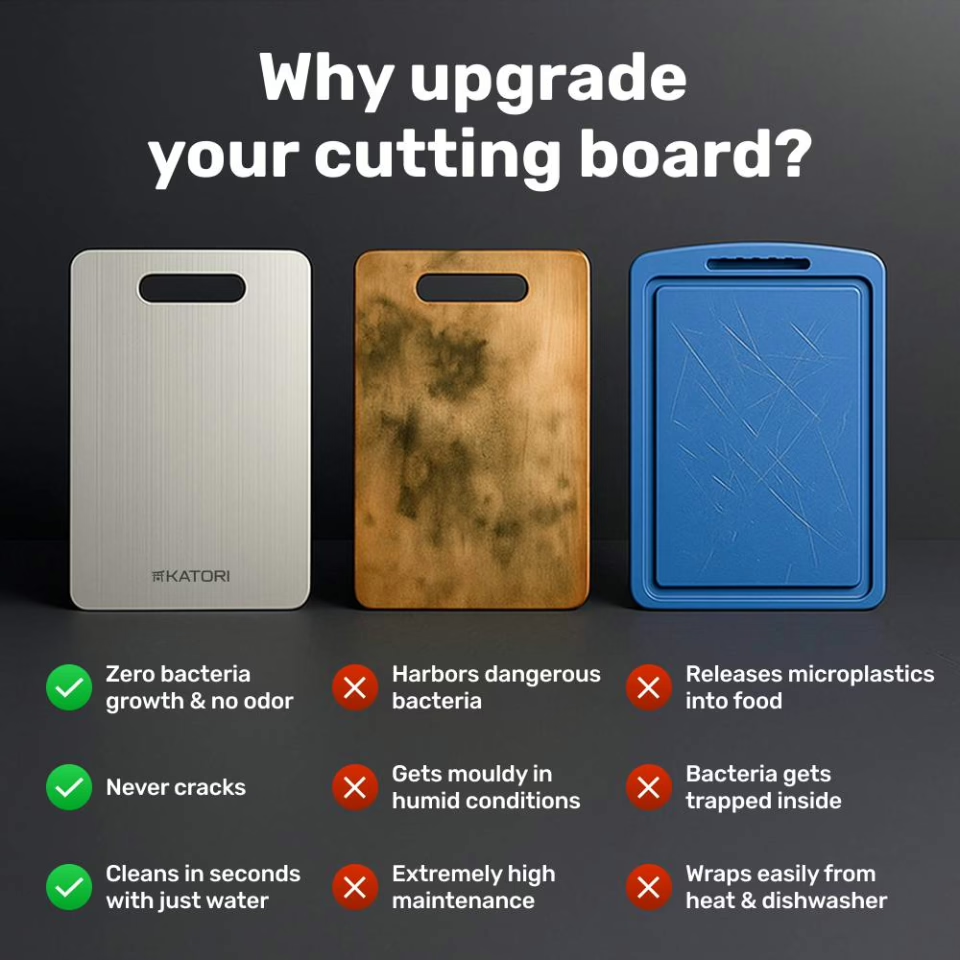
Our recommendation: the Katori titanium cutting board
Now that you know what Katori is, here is our verdict: it is the cutting board we recommend for anyone ready to retire a scored plastic board or a high-maintenance wooden one. It solves the three problems that send people looking in the first place, grooves that are hard to clean, plastic shedding into food and boards that warp or crack, with one simple, non-porous titanium surface that goes straight into the dishwasher.
- 100% titanium, per the maker: no coating to wear through and no plastic side.
- Laser-cut, double-sided surface: one face for raw meat and one for produce.
- Non-porous: juices, smells and stains stay on the surface and wash away.
- Zero microplastics: nothing shed into your food.
- Dishwasher-proof: no warping, cracking or oiling. Size 11.4" x 7.9".
- 30-day money-back guarantee: refund or exchange, with 24/7 support from the official store.
On the official store a single board is currently $59.00 (50% off), the 2-board set is $99.98, three boards are $137.85 and four are $143.60. Shipping is calculated at checkout. The board is rated 4.7/5 by more than 1,894 reviewers.
What is Katori? FAQ
What is Katori?
Katori is a cutting board made of titanium instead of plastic or wood. According to the maker, it is 100% titanium, double-sided with a laser-cut surface, non-porous, free of microplastics and dishwasher-safe. It measures 11.4 by 7.9 inches and is sold through the official store with a 30-day money-back guarantee.
Who makes the Katori cutting board?
According to the maker, Katori was created by Kaito Mason, a culinary coach with two decades of experience as a chef in Japanese cuisine, who wanted a board that was both hygienic and kind to knives.
Is a titanium cutting board better than plastic?
For hygiene and microplastics, a solid metal surface has clear advantages: it does not develop the deep knife grooves that the USDA says make boards hard to clean, and it cannot shed plastic particles into food. It does feel and sound different from plastic, so it takes a few days to get used to.
Does a Katori board dull knives?
Titanium is softer than the hardened steel of a good kitchen knife, and the maker says the board is designed to be gentle on edges. As with any firm board, slice with a gliding stroke instead of chopping straight down, and hone your knife regularly.
How much does Katori cost?
On the official store a single board is currently $59.00 (50% off), two boards are $99.98, three are $137.85 and four are $143.60. Shipping is calculated at checkout, and every order has a 30-day money-back guarantee.
Want to keep learning? Read how the Katori 30-day guarantee works, head back to the Katori overview or read our hands-on Katori review.