Quick answer
A pure titanium cutting board is titanium all the way through; a titanium-coated board is usually steel with a thin titanium-based layer that can scratch and wear off. The quickest checks: titanium feels noticeably light for its size, a fridge magnet does not stick, the edges show the same metal as the surface, and the listing says solid or 100% titanium, not “coated,” “plated” or “stainless + titanium.” The Katori board is described by its maker as 100% titanium, which is why it is the one we recommend.
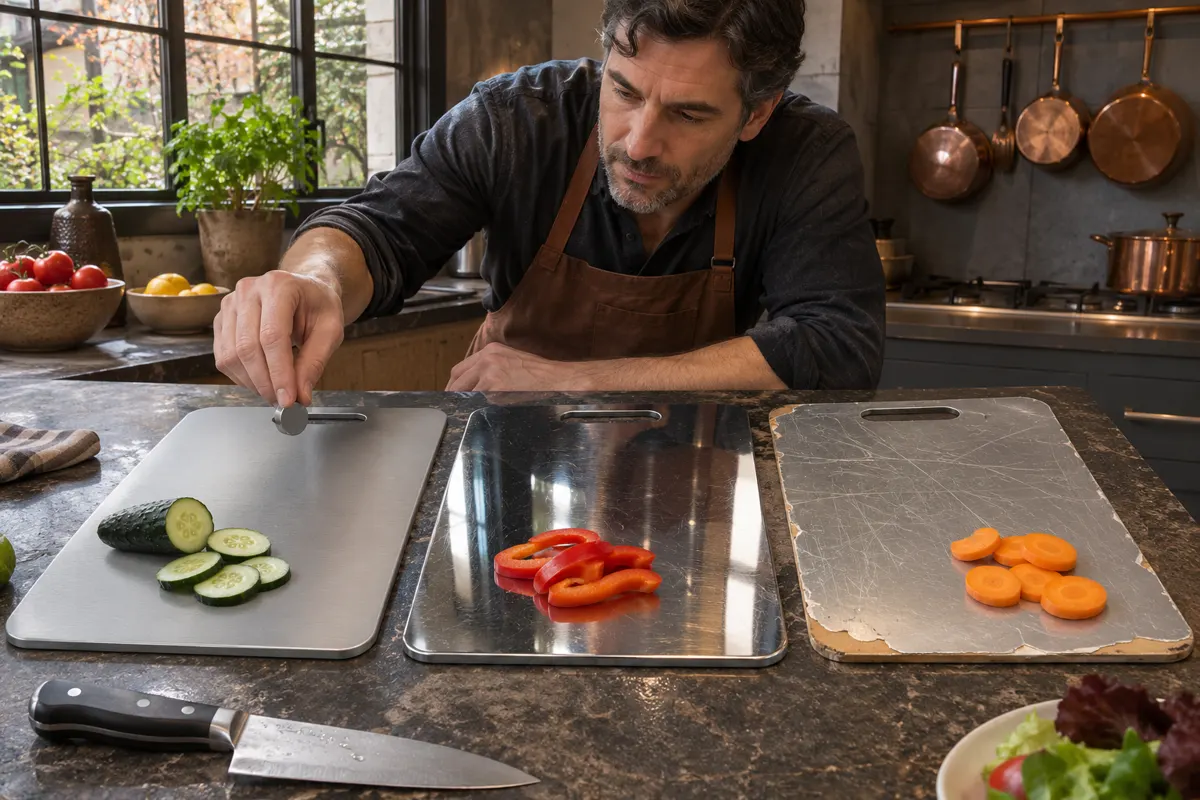
People searching for a “pure titanium cutting board” are usually trying to answer one question: is the board I am looking at really titanium? It is a fair worry. As titanium boards became popular, the word started to appear on very different products. Some are solid titanium sheets. Some are stainless steel with a titanium nitride or titanium-colored coating. And some are ordinary stainless steel boards, sometimes with a plastic side, sold with “titanium” in the title. The differences matter for how the board ages, how heavy it is and what you are actually cutting on.
Three things sold as a “titanium cutting board”
| What matters | Pure (solid) titanium | Titanium-coated steel | Stainless steel “titanium” board |
|---|---|---|---|
| What it is | Titanium all the way through | Steel base with a thin titanium-based surface layer | Stainless steel, sometimes with a plastic side |
| Weight | Light for its size | Heavy, like steel | Heavy |
| Fridge magnet | Does not stick | Often sticks | Sticks to many grades; weak on 304 |
| After scratches | Same metal underneath | Coating can wear and show the base | Steel; plastic side can shed microplastics |
| Listing wording | “100% titanium,” “solid titanium” | “Coated,” “plated,” “titanium finish” | “304 stainless,” “titanium-grade,” “titanium color” |
| Price | Highest of the three | Middle | Often the cheapest |
Why the difference matters
- How it ages: a coating is a surface layer. Every knife stroke, scouring pad and dishwasher cycle works on it. A solid board has no layer to wear through.
- What you are cutting on: on a coated board you cut on the coating while it lasts and on the base metal afterwards. On solid titanium you cut on titanium on day one and on day one thousand.
- Weight: titanium is a much lighter metal than steel, so a solid titanium board is easier to lift, flip and carry to the sink. Our stainless steel cutting board pros and cons explains why heavy steel boards frustrate many cooks.
- Plastic sides: some “titanium” boards are double-sided with a plastic face. That brings back the very issue many buyers are trying to avoid; see microplastics and cutting boards.
6 simple checks: is it real titanium?
- Feel the weightTitanium is roughly 40 percent lighter than steel of the same size. If a thin board feels surprisingly heavy, it is probably steel underneath.
- Try a fridge magnetA magnet will not stick to titanium. If it clings firmly, the board has a steel body. A weak or no pull does not prove titanium on its own, because common 304 stainless steel is also only weakly magnetic, so combine it with the other checks.
- Look at the edges and cornersOn a coated board, edges, corners and the handle cut-out are where the coating wears first. A different color or shine there is a giveaway. Never scratch a board on purpose to test it.
- Read the material line, not the titleTitles are marketing; the specification line is what counts. “Coated,” “plated,” “titanium finish,” “titanium color” or “304 stainless + titanium” all mean it is not solid titanium.
- Check both sidesIf one side is plastic, polypropylene or wheat-straw, you have a mixed board, not a titanium board.
- Sanity-check the price and the guaranteeSolid titanium costs more to make. A very cheap “titanium” board with no return policy deserves a closer look. A real money-back guarantee lets you test the board at home.
What “pure” titanium means (and what it does not)
In everyday use, “pure titanium” or “100% titanium” on a cutting board simply means the board is made of titanium metal, not a coating over something else. Titanium naturally forms a thin, tough oxide layer on its surface the moment it meets air. That layer is part of the metal itself, not an added coating, and it is the reason titanium resists corrosion and stays unreactive with ordinary foods. We cover the safety side in are titanium cutting boards safe? And for how a solid board holds up over months of daily use, see titanium cutting board pros and cons over the long run.
Not sure about the jargon on a product page? Our cutting board terms glossary explains words like non-porous, double-sided and food-grade in plain English.
Where the Katori board fits
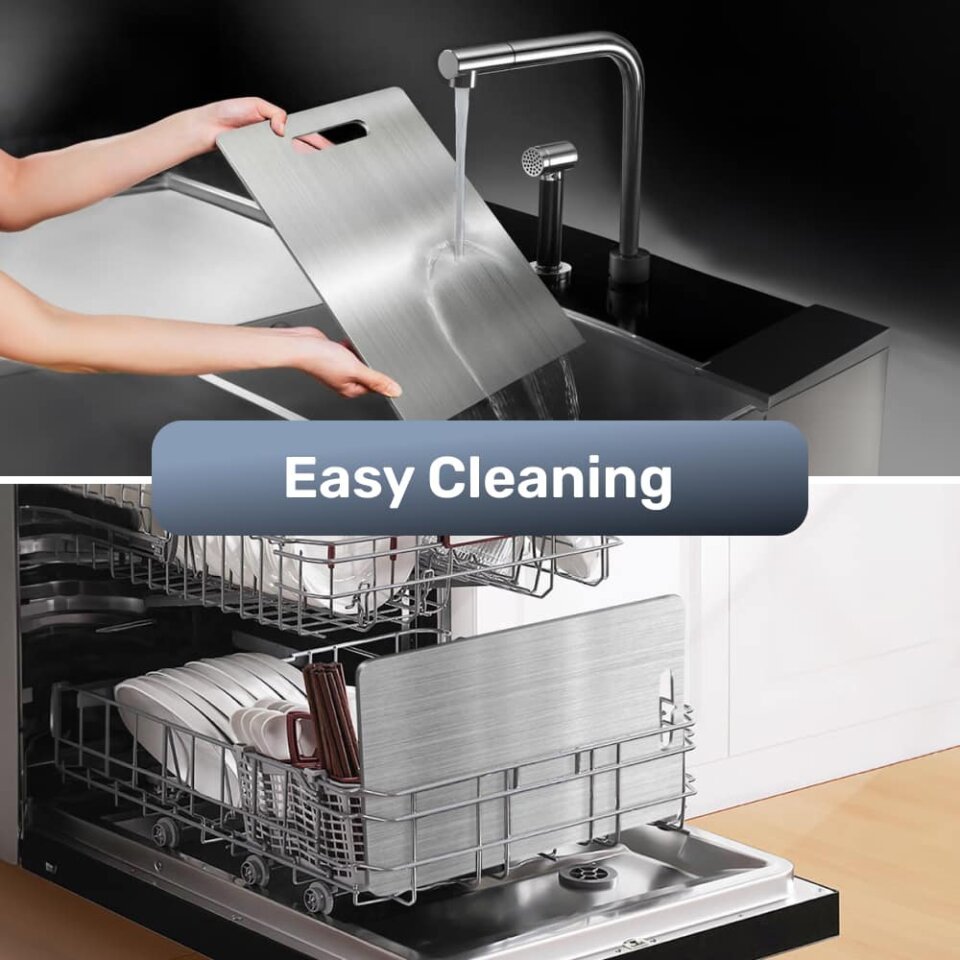
When we looked for a metal board for our own kitchen, this confusion was exactly what we wanted to avoid. The Katori titanium cutting board is described by its maker as 100% titanium, double-sided with titanium on both faces, and dishwasher-safe. It is light enough to lift with one hand, which is the first thing you notice compared with a steel slab.
Our recommendation: the Katori titanium cutting board
If you want a titanium board and not a coating that wears or a steel board borrowing the name, the Katori 100% titanium cutting board is the board we recommend. It is the simplest way to get what people actually mean when they search for a pure titanium cutting board: a light, non-porous, plastic-free surface that stays the same material for as long as you use it.
- 100% titanium, per the maker: no coating to scratch through and no plastic side.
- Light for a metal board: far easier to lift and flip than stainless steel.
- Non-porous: juices, smells and stains stay on the surface and wash away.
- Zero microplastics: nothing shed into your food.
- Laser-cut, double-sided surface: designed by the maker to help knives keep their edge, with one face for raw meat and the other for produce.
- Dishwasher-proof: no warping, cracking or oiling. Size 11.4" x 7.9".
On the official store a single board is currently $59.00 (50% off). Shipping is calculated at checkout. Every order is backed by a 30-day money-back guarantee, so you can do the weight and magnet checks yourself at home, and the board is rated 4.7/5 by more than 1,894 reviewers.
Pure titanium vs. coated boards: FAQ
What is the difference between a pure titanium and a titanium-coated cutting board?
A pure (solid) titanium board is made of titanium all the way through. A titanium-coated board is usually stainless steel or another base material with a thin titanium-based layer on the surface. The coating can scratch or wear over time and expose the metal underneath, while a solid board stays the same material however much you use it.
How can I tell if my cutting board is real titanium?
Check the weight (titanium is roughly 40 percent lighter than steel of the same size), try a fridge magnet (titanium does not stick; many steels do), look at the edges and any scratches for a different metal underneath, and read the material line in the listing. Words like coated, plated, titanium finish or 304 stainless with titanium are signs it is not solid titanium.
Is titanium magnetic?
No, not in a way you can feel. A fridge magnet will not stick to titanium. Keep in mind that some stainless steels, such as the common 304 type, are also only weakly magnetic, so the magnet test can rule a board out but cannot prove on its own that it is titanium.
Is the Katori cutting board pure titanium?
The maker describes the Katori board as 100% titanium, double-sided and dishwasher-safe. That is what sets it apart from coated boards and from stainless steel boards marketed with titanium wording. New to the name? Our explainer what is Katori? The titanium cutting board explained in 3 levels starts from the basics.
Are titanium-coated cutting boards safe?
A coated metal board can be perfectly usable, but you are really cutting on the coating and, once it wears, on the base metal underneath. If you want the full benefits people associate with titanium, a solid titanium board avoids that question entirely.
Why are some titanium cutting boards so cheap?
Titanium is a more expensive metal to produce and machine than steel or plastic, so a very low price is often a hint that the board is coated, is mostly another material, or is a stainless steel board with titanium in the name. Always check the material line and the return policy.
Want to keep learning? Read the best cutting board material, head back to the Katori overview or read our hands-on Katori review.