Quick answer
Replace a cutting board when its surface fails, not on a fixed date. As a rule of thumb, a heavily used plastic board is often due about once a year, and a wooden board every few years — but deep grooves, stains or smells that won't scrub out, cracks or warping mean it's time now. The only way to step off that cycle is a board that doesn't wear that way, like solid non-porous titanium.
There's no law that says "throw out your cutting board every 12 months." What there is is a simple truth: every board is only as safe as its surface. Once that surface is scarred, cracked or stained, cleaning gets less effective, and the board starts working against you. Here's how to tell where yours stands, how long each material realistically lasts, and what to buy so you're not doing this again next year.
How long does each type of cutting board last?
Lifespan depends on how often you cook and how you care for the board, so treat these as rough guides rather than hard limits:
| Material | Typical lifespan | What usually ends it |
|---|---|---|
| Plastic | About a year of daily use | Deep knife grooves, stains, warping in the dishwasher |
| Bamboo | A year or two | Splitting along glue lines, drying out, fuzzy surface |
| Hardwood | Several years (with oiling) | Cracks, warping, lingering odors |
| Glass / stone | Long, until it chips | Chips and breakage — and dull knives along the way |
| Titanium | Built for a lifetime | Nothing routine — no pores, no warping, no re-oiling |
Notice the pattern: the cheaper and softer the board, the faster it wears out. That's why "cheap" boards often end up being the expensive option over a decade.
7 signs your cutting board needs replacing
1. Deep grooves and knife scars
Run your fingers across the board. If you can feel deep cuts — especially a worn "valley" where you chop most — that's the biggest red flag. Grooves are hard to scrub clean, so moisture and food residue can sit inside them long after washing. On a plastic board, those grooves are also proof that the board is wearing away, bit by bit, into whatever you're chopping. We dig into that in our guide to microplastics from plastic cutting boards.
2. Smells that survive a scrub
If garlic, onion, fish or raw meat smells come back even after a hot, soapy wash, the board has absorbed more than you'd like. That's common with porous wood and with heavily scarred plastic. A board that keeps its smell is a board that's keeping other things, too.
3. Stains that won't come out
Beet, turmeric and tomato stains on their own aren't dangerous, but stubborn discoloration usually means the surface has become rough and porous enough to trap pigment. Where color soaks in, juices can soak in.
4. Cracks or splits
Wood and bamboo boards can crack when they dry out or get soaked. A crack is a hidden channel for moisture and food particles, and it tends to grow. Once a board splits, it's time to retire it.
5. Warping or wobbling
A board that rocks on the counter isn't just annoying — it's a knife-safety issue. Plastic boards often warp from dishwasher heat; wooden boards warp from uneven drying. A wobbly board makes slips more likely.
6. A fuzzy or rough surface
When a plastic board starts to feel furry, or a bamboo board gets splintery, the surface is breaking down. Those loose fibers and flakes don't stay on the board — they travel with your food.
7. You can't remember when you bought it
If the board has been through countless raw-chicken nights and you honestly can't recall when it arrived, give it a hard look under good light. Chances are at least one of the signs above is already there.
Can you rescue an old board instead?
Sometimes. A wooden board with shallow marks can be sanded smooth and re-oiled, which buys it more time. A good routine also helps every board last longer:
- Wash right after use with hot, soapy water and dry it standing up so air reaches both sides (our step-by-step guide on how to clean a cutting board after raw meat covers sanitizing too).
- Keep raw and ready-to-eat separate — a dedicated board (or side) for raw meat cuts cross-contamination risk.
- Oil wood and bamboo regularly so they don't dry out and crack.
- Keep wood out of the dishwasher and out of the sink overnight.
Plastic is the hard one. You can't really sand it at home without creating plastic dust, and once the grooves are deep, no amount of scrubbing gets them perfectly clean. For most people, a scarred plastic board is a "replace it" board.
The smarter move: stop replacing boards altogether
Every material above wears out for the same reason: its surface is either soft enough to scar or porous enough to absorb. Glass and stone avoid that, but they blunt your knives fast (more on that in how to keep your kitchen knives sharp).
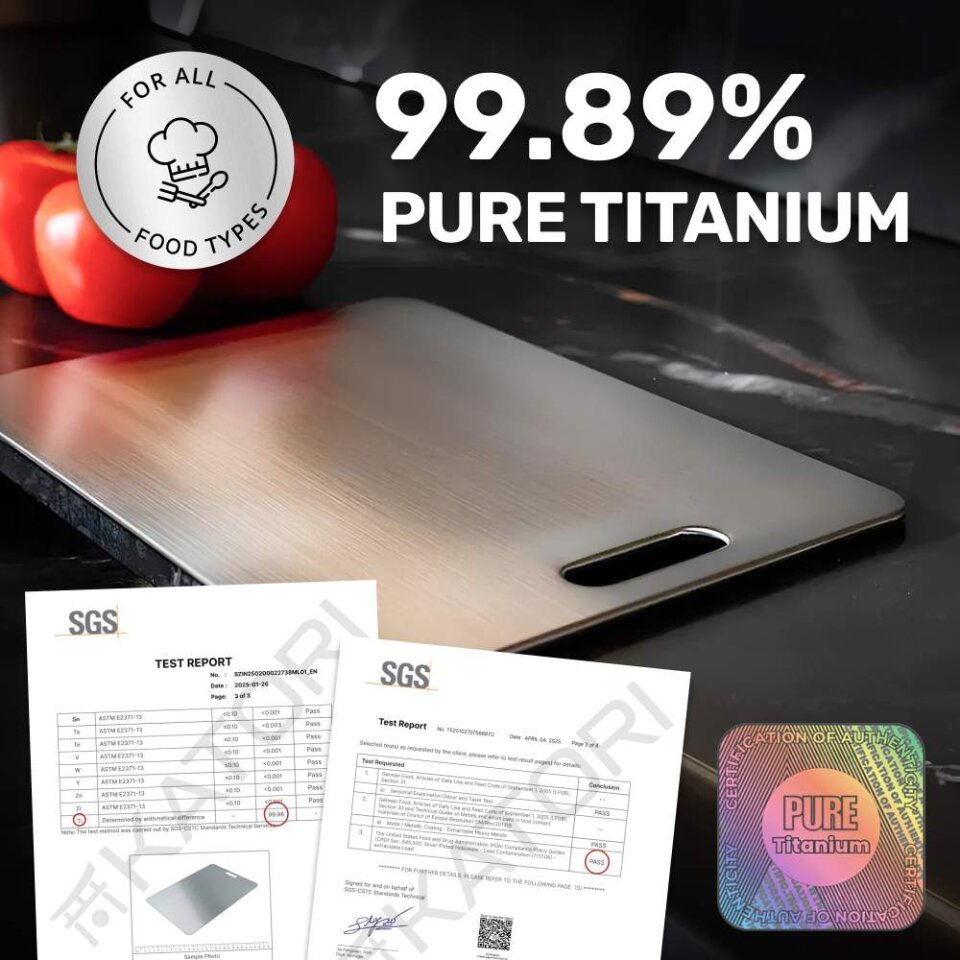
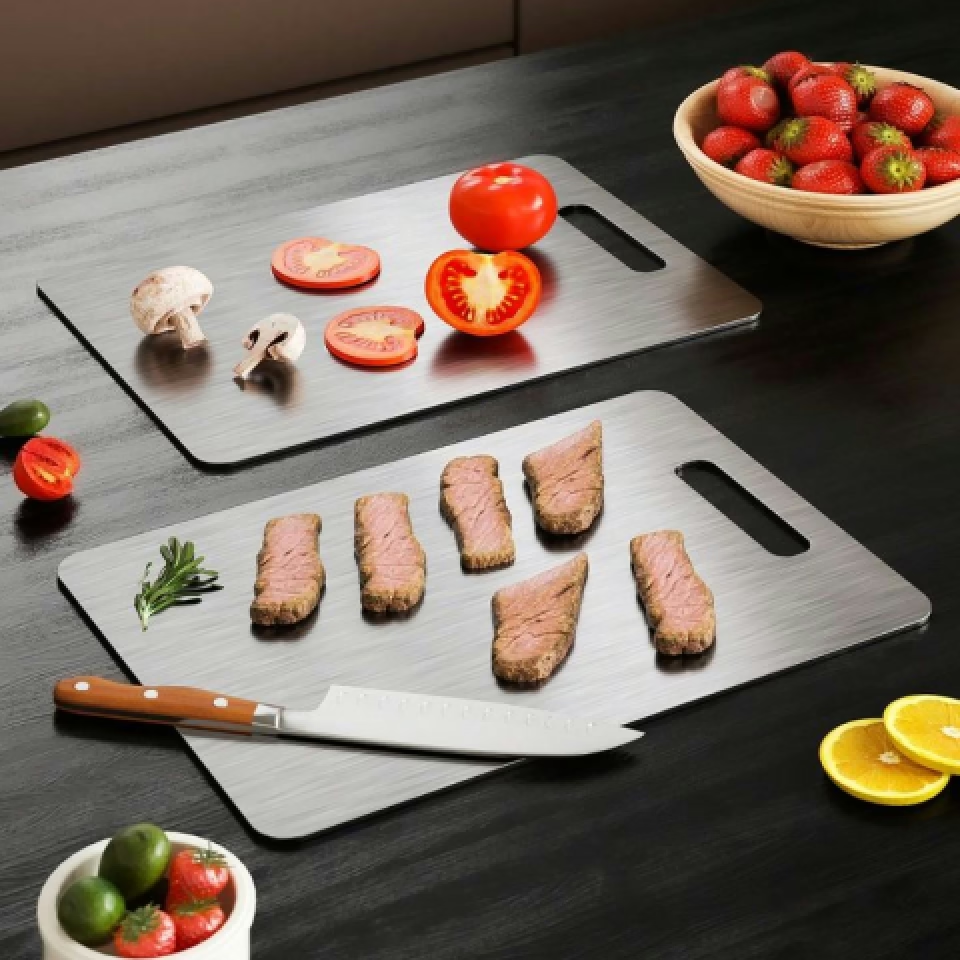
That's exactly the gap the Katori titanium cutting board fills. It's machined from 100% pure titanium, so there are no pores for juices or odors to sink into and no soft surface to carve into deep grooves. It's heat-proof, stain- and odor-resistant, double-sided (one side for raw, one for ready-to-eat), dishwasher-safe, and it sheds zero microplastics. Instead of a board you replace every year, it's a board you buy once.
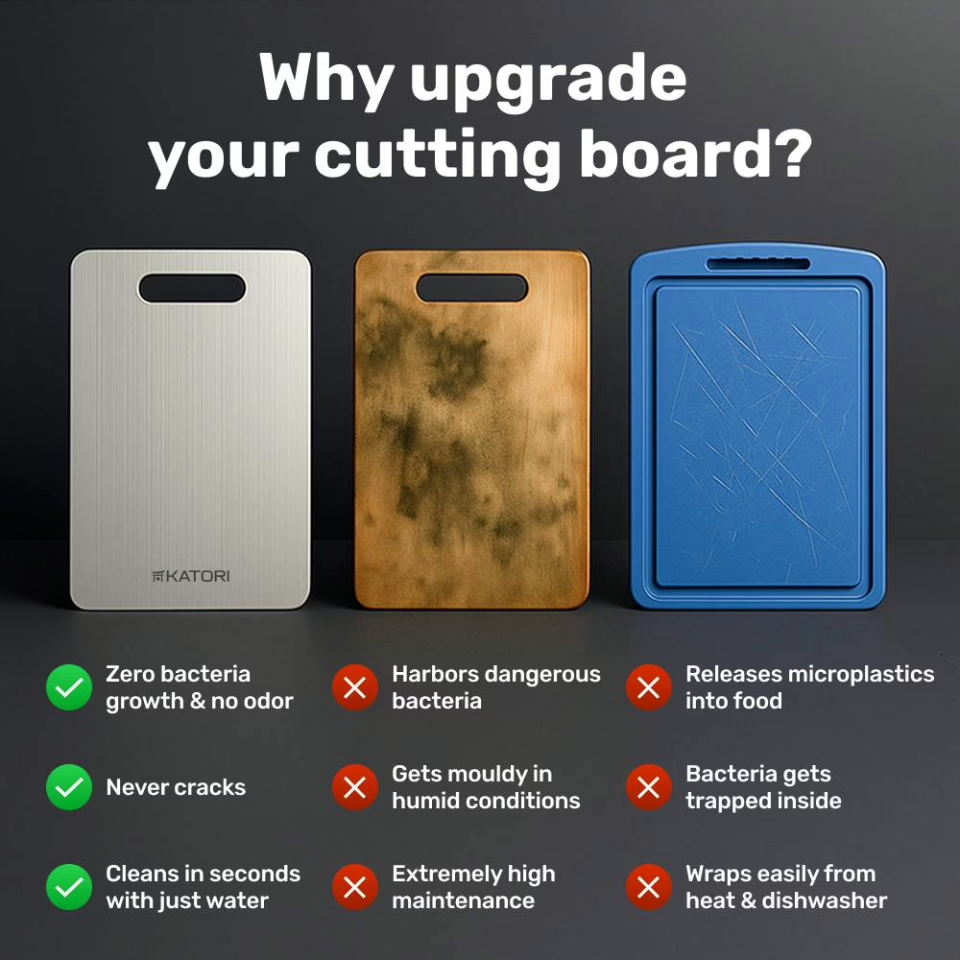
The honest trade-offs: it's a firmer surface than soft wood, so it takes a day or two to get used to, and it costs more upfront than a plastic sheet. But when you compare it with a new plastic board every year, the "buy it once" math tends to win — and you get a cleaner surface from day one. If you want the full breakdown, our wood vs plastic vs titanium comparison scores every material side by side.
Our recommendation: the Katori titanium cutting board
If you spotted two or three of the warning signs above, don't just buy another board that will wear out the same way next year. The Katori 100% titanium cutting board is the board we recommend, because it's built to avoid every one of those seven signs in the first place.
- No deep grooves: solid titanium resists the knife scarring that turns plastic boards fuzzy and hard to clean.
- No lingering smells or stains: the surface is non-porous, so garlic, fish and tomato sauce rinse off instead of soaking in.
- No warping or cracking: there's no wood to dry out and no thin plastic to bend in a hot dishwasher.
- No microplastics: nothing wears off the board into your food, year after year.
- Built-in separation: it's double-sided, so raw meat and ready-to-eat food each get their own face.
On the official store a single board is currently $59.00 and the best-selling 2-board set is $99.98, with shipping calculated at checkout. Every order is backed by a 30-day money-back guarantee. One board for life instead of a new one every year is the simplest way to stop the replacement cycle for good.
Cutting board replacement FAQ
How often should you replace a plastic cutting board?
Many food-safety guides suggest roughly once a year for a plastic board that gets daily use, and sooner if it has deep grooves, stains or smells that won't wash out. Light use can stretch that, but the condition of the surface matters more than the calendar.
How long does a wooden cutting board last?
A well-oiled hardwood board can last several years. Replace it once it cracks, splits, warps, or holds onto odors after a thorough scrub, because those cracks can trap moisture and food residue.
Can you sand a cutting board instead of replacing it?
Wood boards can often be sanded and re-oiled to remove shallow knife marks. Plastic boards are much harder to resurface at home, and sanding them creates fine plastic dust, so replacing them is usually the simpler option.
Is it bad to use a cutting board with deep cuts?
Deep grooves are hard to clean properly, so food residue and moisture can sit in them. On plastic boards, a heavily scarred surface also means the board is wearing away, which is how microplastic fragments end up in food.
Is there a cutting board you never have to replace?
A solid, non-porous titanium board like Katori is built to last for life: it doesn't scar into deep grooves, doesn't absorb juices or smells, doesn't warp, and is dishwasher-safe.
Want to see how the board performs day to day? Head back to the Katori overview or read our hands-on Katori review.