Quick answer
Stainless steel cutting boards are excellent for hygiene and durability, and weaker on knife-friendliness and comfort. Pros: non-porous, easy to sanitize, dishwasher-safe, no microplastics, they never crack or warp. Cons: a hard steel surface wears knife edges faster, the boards can be loud and slippery, and they are heavy. If you want the hygiene of metal in a lighter board designed to be kinder to knives, the Katori titanium cutting board is the alternative we recommend.
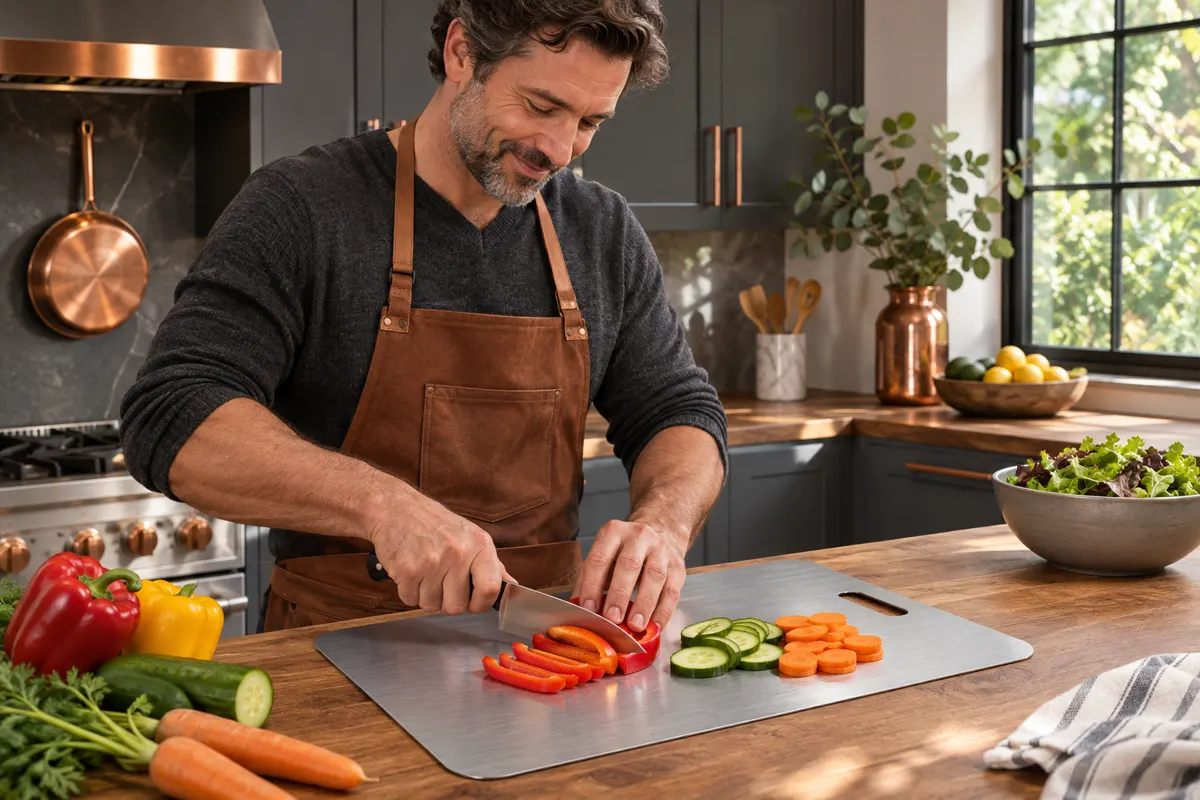
Searches for “stainless steel cutting board pros and cons” have climbed sharply this fall. It makes sense: people are tired of plastic boards that shed shavings and wooden boards that need oiling, and a sheet of steel looks like the obvious, indestructible answer. It is a great answer for some kitchens and an annoying one for others. This guide answers the question directly, then shows how titanium, the other metal board, compares.
The pros of a stainless steel cutting board
- Non-porous and hygienic: juices, garlic and fish smells stay on the surface instead of soaking into grooves, so a wash really cleans it.
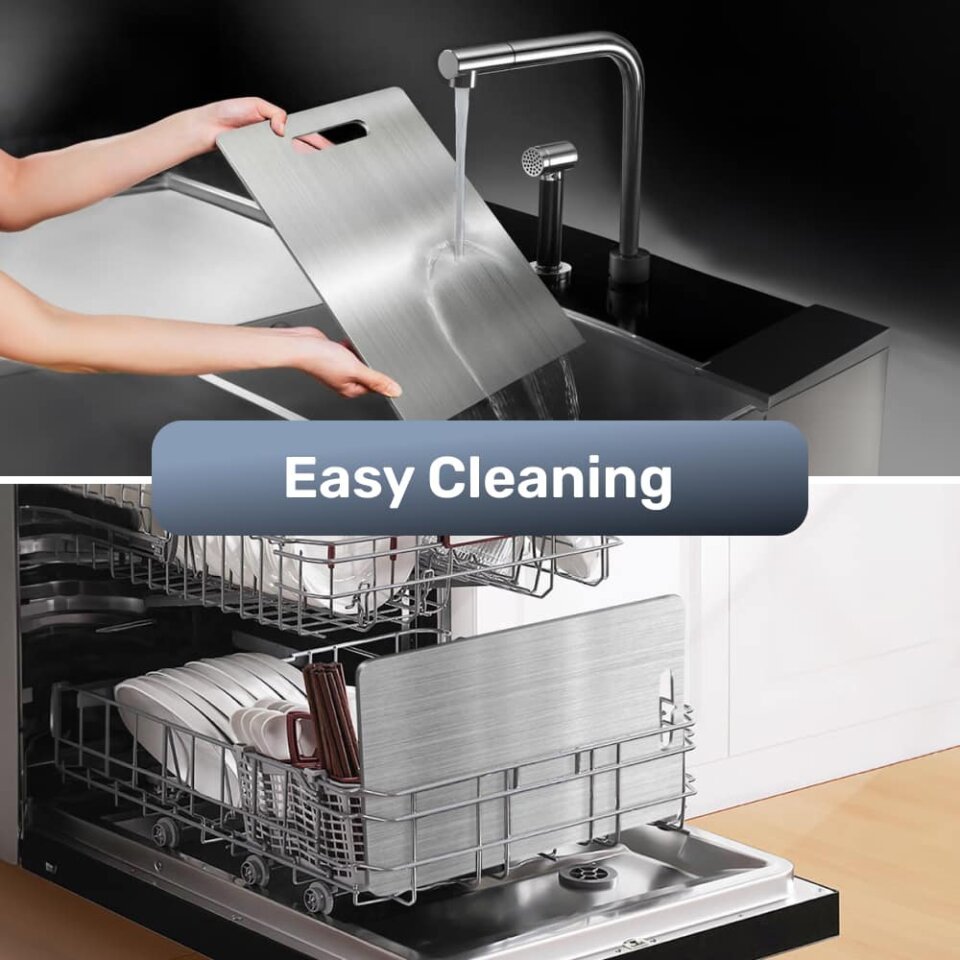
- Dishwasher-safe: no warping, splitting or special care.
- No microplastics: unlike plastic boards, there are no shavings to end up in your food (more on that in microplastics and cutting boards).
- Extremely durable: it will not crack, chip or stain the way wood and plastic can.
- Great for raw meat and dough: easy to sanitize after chicken, and a cool, smooth surface for rolling pastry.
The cons of a stainless steel cutting board
- Hard on knife edges: a very hard surface wears an edge faster than wood or plastic, so knives need honing and sharpening more often.
- Noisy: every chop rings out, which some cooks love and many do not.
- Slippery: the board can slide on the counter and wet food can skid on the surface.
- Heavy: steel is a dense metal, so a full-size board is a workout to lift to the sink.
- Shows marks: fingerprints and fine scratches are visible on brushed steel.
Stainless steel vs. titanium vs. the usual boards
| What matters | Stainless steel | Titanium (Katori) | Wood / bamboo | Plastic |
|---|---|---|---|---|
| Non-porous | Yes | Yes | No | Until it scratches |
| Microplastics | None | None | None | Can shed |
| Dishwasher | Yes | Yes | No | Usually |
| Knife-friendliness | Tough on edges | Surface designed to protect the edge, per the maker | Gentle | Gentle |
| Weight | Heavy | Light | Medium to heavy | Light |
| Care | Wash and go | Wash and go | Oiling, hand wash | Replace when grooved |
The full material-by-material picture is in our guide to the best cutting board material.
Who a stainless steel board suits
Steel is a good fit if you mainly want an easy-clean surface for raw meat, you bake and like a cool board for dough, or you do not mind sharpening your knives a bit more often. It is less pleasant for people who chop a lot of vegetables every day with good knives, who cook late at night in a shared apartment, or who find heavy boards a chore to lift.
How to get the best from any metal board
- Stop the slideA damp towel or a thin silicone mat underneath keeps the board steady and quieter.
- Slice, do not hackA forward or rocking slicing motion is kinder to the edge than chopping straight down.
- Hone oftenA few strokes on a honing rod before you cook keeps the edge aligned.
- Two zonesKeep raw meat and ready-to-eat food on separate boards or sides, and wash between them.
- Clean straight awayHot soapy water or the dishwasher right after raw meat, poultry or fish. Our guide to cleaning a board after raw meat has the steps.
Why titanium is the metal board we prefer
Titanium keeps everything people like about steel, the non-porous surface, zero microplastics and dishwasher-proof toughness, and answers two of its biggest complaints. Titanium is a much lighter metal than steel, so the board is easy to lift, flip and carry to the sink. And the Katori board is made with a laser-cut surface that the maker designed to help knives keep their edge, instead of being a plain sheet of hard steel.
Our recommendation: the Katori titanium cutting board
If the pros of stainless steel appeal to you but the cons do not, the Katori 100% titanium cutting board is the board we recommend. It is the most practical way to get a hygienic, plastic-free metal board that is light, double-sided and built for everyday chopping.
- Non-porous 100% titanium: juices, smells and stains stay on the surface and wash away.
- Zero microplastics: nothing shed into your food.
- Laser-cut surface: designed by the maker to help knives keep their edge.
- Double-sided: one face for raw meat and fish, the other for produce and bread.
- Dishwasher-proof: no warping, cracking or oiling.
- Handy size: 11.4" x 7.9", light enough to grab with one hand.
On the official store a single board is currently $59.00 (50% off), the best-selling 2-board set is $99.98 ($49.99 each), the 3-board set is $137.85 ($45.95 each) and the 4-board set is $143.60 ($35.90 each). Shipping is calculated at checkout. Every order is backed by a 30-day money-back guarantee, and the board is rated 4.7/5 by more than 1,894 reviewers.
Stainless steel cutting boards: FAQ
Are stainless steel cutting boards good?
They are excellent for hygiene and durability: non-porous, easy to sanitize, dishwasher-safe and free of microplastics. Their main drawbacks are that a hard steel surface is tough on knife edges, they can be noisy and slippery, and they are heavy. They suit people who prioritize easy cleaning, especially for raw meat.
Do stainless steel cutting boards dull knives?
A very hard surface wears a knife edge faster than a softer one such as wood or plastic, so most cooks find their knives need honing and sharpening more often on steel. How much depends on the knife, the steel and your cutting style; slicing rather than chopping straight down helps.
Are stainless steel cutting boards hygienic?
Yes. Stainless steel is non-porous, so juices and bacteria stay on the surface where hot soapy water or a dishwasher can remove them. As with any board, clean it right after raw meat, poultry or seafood and keep a separate surface or side for ready-to-eat foods.
What is the difference between a stainless steel and a titanium cutting board?
Both are non-porous metals that do not shed microplastics and go in the dishwasher. Titanium is a much lighter metal than steel, so a titanium board is easier to lift and move, and makers of titanium boards such as Katori design the surface to be kinder to knives. Steel boards are often heavier and noisier.
Can you cut raw meat on a stainless steel board?
Yes, it is one of the best uses for a metal board because it cleans so easily. Wash it with hot soapy water or run it through the dishwasher straight after, and do not cut ready-to-eat food on it until it is clean.
How do I stop a metal cutting board from slipping?
Put a damp kitchen towel or a thin silicone mat under the board. That keeps it steady on the counter and also softens the noise of the knife.
Want to keep learning? Read are titanium cutting boards safe?, see how to keep your knives sharp, head back to the Katori overview or read our hands-on Katori review.