Quick answer
Every cutting board wears a knife edge over time, but a solid titanium board is far from the knife-killers people fear. Commercially pure titanium is considerably softer than the hardened steel of a kitchen knife, while glass and stone, the real edge-wreckers, are not. Because metal is firmer than wood, technique matters: slice with a gliding stroke, do not scrape with the edge and hone regularly. Get those habits right and you keep the big wins (non-porous, no microplastics, no warping, dishwasher-safe), which is why the Katori 100% titanium board is the one we recommend.
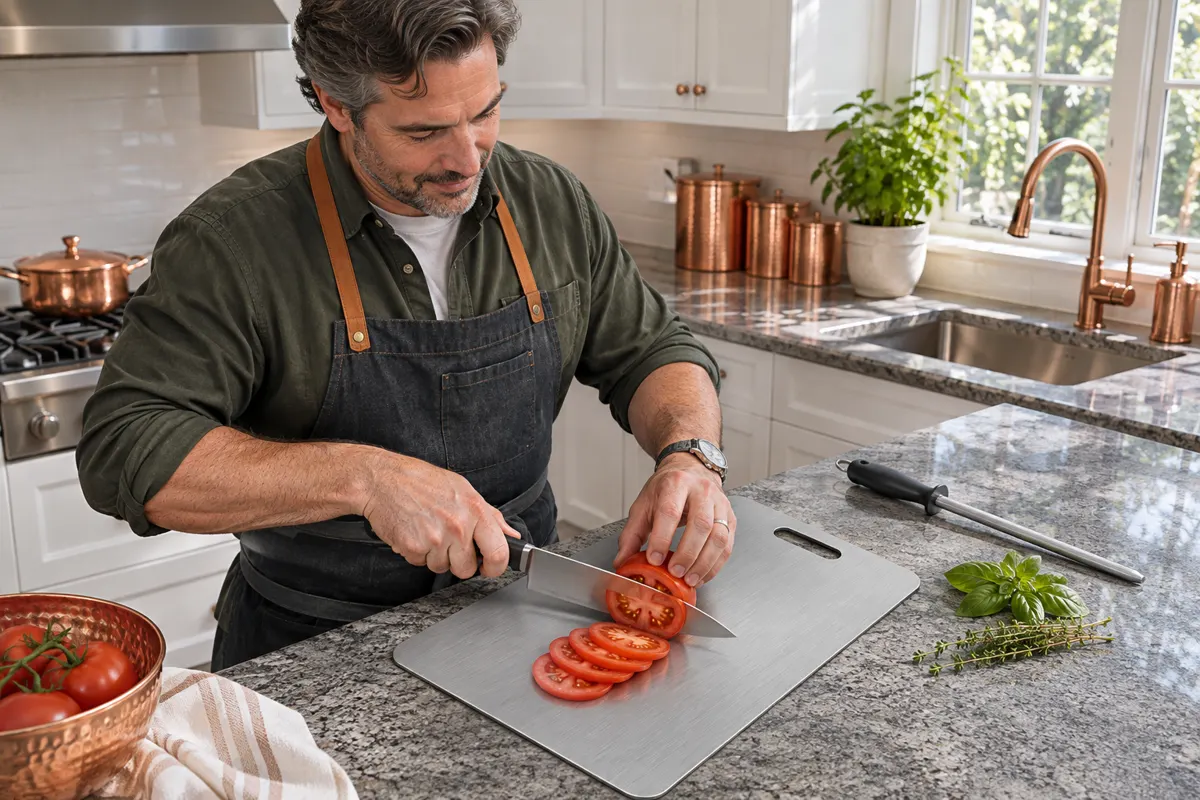
“Do titanium cutting boards dull knives?” is one of the fastest-rising titanium board searches on Google this fall, and it is a fair question. If you have spent good money on a chef's knife, you do not want a board that ruins it. Skepticism is healthy here, so instead of a sales pitch, here are straight answers to the seven doubts we hear most, including the ones that are slightly suspicious of the whole trend.
1. “Will a metal board ruin my knives?”
Start with how an edge dulls. A knife edge is a very thin strip of hardened steel. Each time it meets the board, the very tip can roll over or chip a little. Two things decide how fast that happens: how hard the surface is compared with the steel, and how you strike it.
On hardness, the surfaces that really wreck edges are the ones as hard as or harder than knife steel: glass, granite, marble and ceramic. That is why kitchen experts warn against glass boards. Commercially pure titanium is considerably softer than hardened kitchen-knife steel, so it sits in a very different category from glass or stone. It is, however, firmer than wood or plastic, which give a little under the edge.
That is where technique comes in. Hard chopping, rocking an edge into the board with force, or scraping chopped food across the surface with the sharp side are what wear any edge quickly, and they show up more on a firm board. A gliding slice, a light touch and scraping with the spine of the knife keep your edge in good shape. Our guide on keeping kitchen knives sharp covers honing and sharpening.
| Surface | Compared with knife steel | What it means for your edge |
|---|---|---|
| Glass, granite, marble, ceramic | As hard or harder | Fastest dulling; avoid for cutting |
| Solid titanium | Softer, but firm | Fine with a slicing motion and regular honing |
| Wood and bamboo | Much softer, slight give | Gentle on edges; needs oiling, can crack |
| Plastic | Much softer | Gentle on edges; scores and sheds particles over time |
2. “Isn't this just a social media fad?”
The buzz is recent; the material is not. Titanium is valued in demanding uses precisely because it resists corrosion, is strong for its weight and does not react easily. What made it popular in kitchens is a practical problem: plastic boards scored by knives, and the worry about microplastics from plastic cutting boards. A non-porous metal surface that sheds no plastic, does not warp and survives the dishwasher solves that. A fad is something with no reason behind it; this has several.
3. “Is it even real titanium?”
This is the smartest question on the list, because not every “titanium” board is the same. Some are stainless steel with a thin titanium coating, which can wear through at the edges. Look for a clear “solid” or “100% titanium” claim, a listed weight and a seller who stands behind the product. We explain the differences in pure titanium vs. titanium-coated cutting boards. The Katori board is described by its maker as 100% titanium.
4. “Won't it be loud and slide around?”
Honestly, it sounds different from wood. And any smooth, light board can slide on a smooth counter. Both have the same two-second fix: lay a damp kitchen towel or thin silicone mat under the board. It grips the counter, keeps the board rock-steady for safe cutting and softens the sound. Most owners stop noticing after the first week.
5. “Is it actually more hygienic?”
A titanium board is non-porous: juices sit on the surface instead of soaking into grooves or wood grain, and it can go in the dishwasher. That makes it easy to get properly clean. It is not magic, though. Food-safety basics still apply: wash boards with hot, soapy water after raw meat, and keep raw meat and ready-to-eat food apart, which the double-sided Katori design makes simple. Our step-by-step guide on cleaning a cutting board after raw meat has the routine.
6. “Why is it sold online and not at my store?”
Many newer kitchen products are sold direct from the maker's official store instead of through big retail chains. That is how Katori is sold. It is also where you get the current discount and the guarantee, and where you avoid lookalikes: if you see a “Katori” board somewhere else at a suspicious price, it is worth double-checking what you are buying.
7. “What if I just don't like it?”
That is what a guarantee is for. Katori orders from the official store come with a 30-day money-back guarantee, so you can cook with it for a few weeks, slice your usual vegetables, carve a roast, run it through the dishwasher, and decide. Keep the packaging during the first month to make a return easy.
We walk through every step, from the dates to note to what to ask support, in our guide to the Katori cutting board guarantee.
The skeptic's scorecard
| The doubt | Honest answer | Verdict |
|---|---|---|
| Dulls knives? | Softer than knife steel, firmer than wood | Fine with good technique |
| Just a fad? | Solves real plastic and wood problems | Practical reasons behind it |
| Real titanium? | Check for solid / 100% claims | Katori: 100% titanium per maker |
| Loud, slippery? | Damp towel underneath | Easy fix |
| More hygienic? | Non-porous, dishwasher-safe | Yes, with normal washing |
| Only online? | Sold direct from the official store | Discount and guarantee there |
| If I don't like it? | 30-day money-back guarantee | Low risk |
4 habits that protect your edge on any firm board
- Slice, don't slamLet the blade glide forward or back through the food instead of chopping straight down with force.
- Scrape with the spineFlip the knife over to push chopped food aside; the sharp edge stays sharp.
- Hone little and oftenA few strokes on a honing steel before you cook realigns the edge.
- Hand-wash your knivesThe dishwasher is fine for the board, not for good knives.
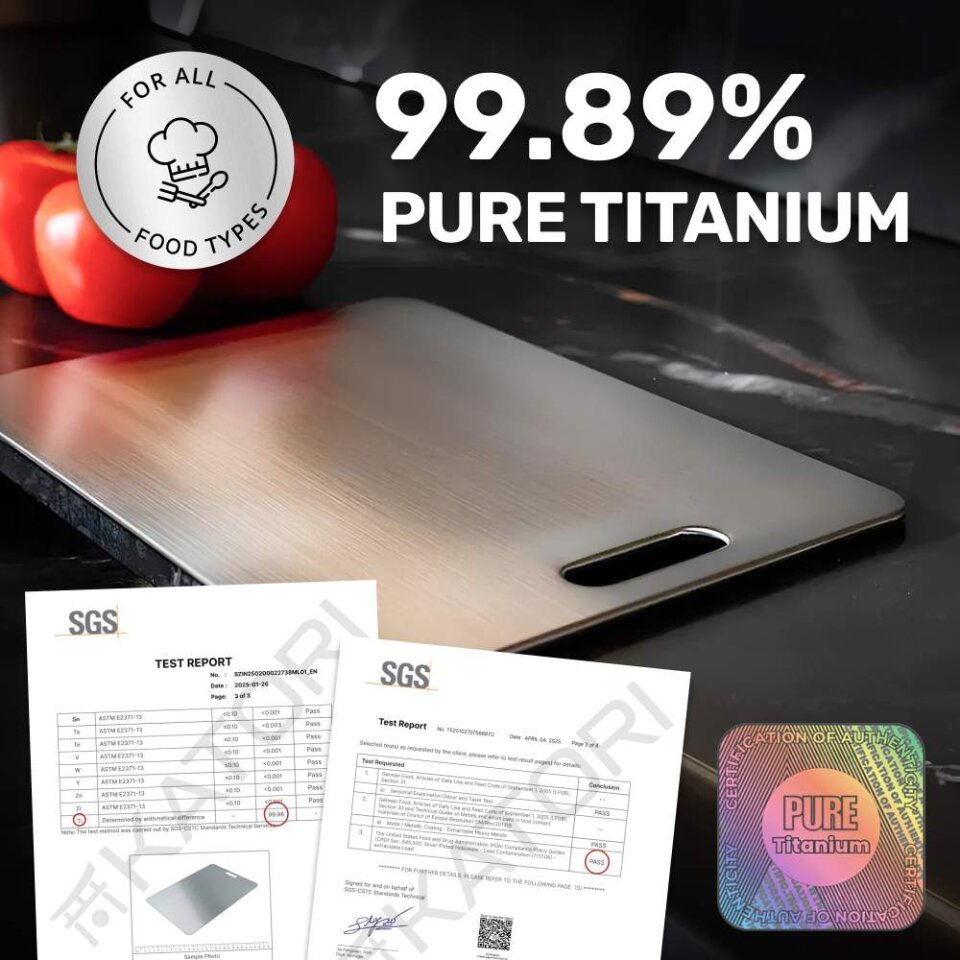
Our recommendation: the Katori titanium cutting board
After working through every doubt, our conclusion is clear: if you want to leave scored plastic and high-maintenance wood behind, the Katori 100% titanium cutting board is the one we recommend. It is the most practical way to get a non-porous, plastic-free prep surface that handles daily cooking and the dishwasher, and with the simple edge habits above, your knives stay happy too.
- 100% titanium, per the maker: no coating to wear through and no plastic side.
- Laser-cut, double-sided surface: designed by the maker to help knives keep their edge, with one face for raw meat and one for produce.
- Non-porous: juices, smells and stains stay on the surface and wash away.
- Zero microplastics: nothing shed into your food.
- Dishwasher-proof: no warping, cracking or oiling. Size 11.4" x 7.9".
- Light for a metal board: easy to lift, flip and carry to the sink.
On the official store a single board is currently $59.00 (50% off), and the 2-board set is $99.98. Shipping is calculated at checkout. Every order is backed by a 30-day money-back guarantee, and the board is rated 4.7/5 by more than 1,894 reviewers.
Do titanium cutting boards dull knives? FAQ
Do titanium cutting boards dull knives?
Every cutting surface wears a knife edge over time. Commercially pure titanium is considerably softer than the hardened steel of a kitchen knife, unlike glass or stone, which are among the worst surfaces for an edge. A metal board is firmer than wood, so technique matters: slice with a gliding motion instead of chopping hard, avoid scraping food with the edge, and hone your knife regularly.
Are titanium cutting boards just a fad?
The trend is recent, but the reasons behind it are practical: titanium is a corrosion-resistant, non-porous metal that does not shed plastic particles, warp or crack. Whether it suits you depends on how you cook, which is why a money-back guarantee is worth checking before you buy.
How do I know a cutting board is really pure titanium?
Look for a clear statement that the board is solid or 100% titanium rather than titanium-coated or titanium-plated, check the listed weight and look at the edges, where a coating can show a different metal underneath. The Katori board is described by its maker as 100% titanium.
Is a titanium cutting board loud or slippery?
It sounds different from wood, and like any smooth board it can slide on a smooth counter. A damp kitchen towel or thin silicone mat underneath keeps it steady and softens the sound.
Can I return a Katori board if I do not like it?
Katori orders from the official store come with a 30-day money-back guarantee. Check the current terms on the official checkout when you order.
Want to keep learning? Read titanium cutting board pros and cons over 12 months, head back to the Katori overview or read our hands-on Katori review.