Quick answer
Yes, a solid titanium cutting board is a safe surface for food. Titanium is a stable, corrosion-resistant metal that does not react with ordinary foods, acids or oils, and a 100% titanium board has no plastic, glue or coating that could wear off into your meal. It is non-porous, so raw juices and odors stay on the surface and wash away, and it can go in the dishwasher. The one thing to check is that the board is really solid titanium, like the Katori titanium cutting board, and not a look-alike.
Most of us grew up with wooden boards and plastic boards and never questioned them. Then came the headlines about microplastics from plastic boards and the reminders that wood soaks up raw-meat juices, and suddenly a lot of home cooks started looking at titanium. The question we get most often isn't "does it work?" but something quieter: "Is metal really OK to cut my food on? Is it toxic? What happens in the dishwasher?" Let's go through it calmly.
What titanium actually is
Titanium is a naturally occurring metal known for three things: it is strong, it is light, and it is extremely resistant to corrosion. When titanium meets air, it instantly forms a thin, tough oxide layer on its surface. That layer is what keeps it from rusting and what makes it so unreactive. It is the reason titanium is trusted in places where a material must stay stable for years in contact with water, salt and even the human body, such as surgical implants, dental implants, watch cases and high-end cookware.
For a cutting board, that stability matters more than strength. A board spends its life touching lemon juice, vinegar, tomato, raw meat, salt and hot water. You want a surface that simply doesn't care.
Is it safe for food? The four things that matter
| Question | Solid titanium board | Why it matters |
|---|---|---|
| Does it react with food? | No, it is inert with acids, oils and salt | No metallic taste, no discoloration, nothing transferred to food |
| Does it absorb juices? | No, it is non-porous | Raw-meat juices, bacteria and odors stay on the surface and wash off |
| Does it shed anything? | No plastic, glue or coating to break down | No microplastics and no worn-off finish in your food |
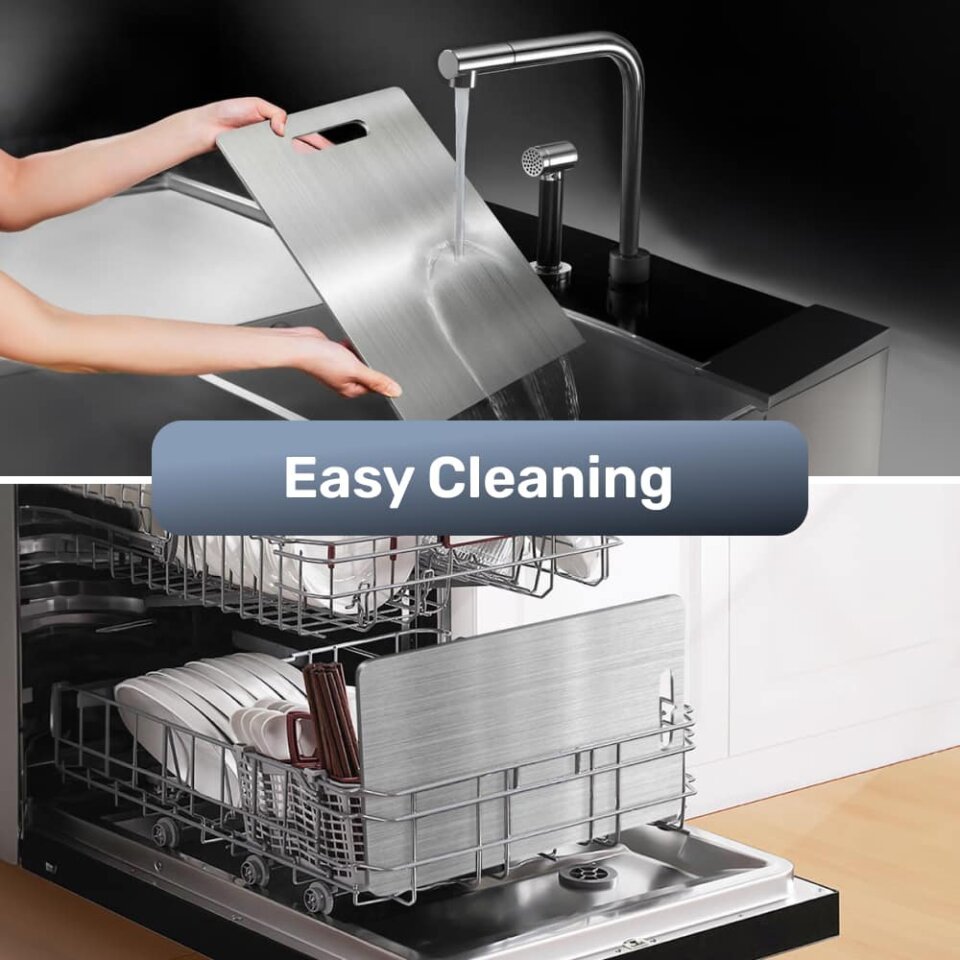
| Does it tolerate heat? | Yes, dishwasher-safe and won't warp | You can clean it thoroughly every single time |
Compare that with the two boards most kitchens already own. Plastic is non-porous at first, but every knife stroke cuts grooves into it, and those grooves trap moisture and bacteria while shedding tiny particles (we cover this in microplastics from cutting boards). Wood is lovely to use, but it is porous, needs hand-washing and oiling, and can crack in the dishwasher. For a side-by-side look, see wood vs. plastic vs. titanium.
Questions people rarely ask (but should)
"Will a metal board leave metal in my food?"
This is the most common worry, and it comes from experiences with cheap metal tools that rust or flake. A solid titanium board is a single, uncoated material with a protective oxide surface. There's no paint, plating or non-stick layer to chip, and titanium doesn't rust. What you cut on it is what you eat.
"Is it OK to cut acidic foods like lemons and tomatoes on it?"
Yes. Acidic foods are exactly where titanium's corrosion resistance shines. Unlike some metals, it doesn't react with citrus, tomatoes or vinegar marinades, so you won't get off-flavors or stains.
"Can I put raw chicken on it and then vegetables?"
The same rule applies to every board: don't let raw meat juices touch ready-to-eat food. What changes with titanium is how easy it is to clean properly. Because nothing soaks in, hot soapy water or a dishwasher cycle actually gets it clean. On a double-sided board, the simplest habit is one face for raw meat and the other for produce. Our guide on cleaning a cutting board after raw meat walks through the routine.
"Is the dishwasher safe for it, or will heat damage it?"
Dishwasher heat is no problem for solid titanium. There's no glue to dissolve, no wood fibers to swell and crack, and no plastic to warp. That's a real safety advantage: the board you can clean thoroughly every night is the board that stays hygienic.
"Can I set a hot pan on it?"
Titanium handles heat far better than plastic or wood, so a warm pan or a pot you just took off the burner won't scorch or melt it the way it would a plastic board. As with any metal, it will get hot itself, so handle it with care afterward.
"What about people with metal sensitivities?"
Titanium is widely regarded as one of the most biocompatible metals, which is why it's so common in implants and in jewelry for sensitive skin. If you have a diagnosed metal allergy or a specific medical concern, your doctor is the right person to ask, but titanium is generally considered a very low-risk material.
"Is every 'titanium' board really titanium?"
Not always, and this is the one safety check worth doing. Some cheap boards sold online turn out to be stainless steel, or a plastic board with a single metal-colored side. Stainless steel is also food-safe, but it isn't titanium, and a plastic back still sheds plastic. Read the description: you want a board described as solid, 100% titanium. Katori is described by its maker as 100% titanium, double-sided and laser-cut.
Simple habits for the safest results
- Wash after every raw-meat job — hot soapy water or straight into the dishwasher.
- Dedicate a side — one face for raw meat, one for produce and ready-to-eat foods.
- Dry before storing — titanium won't mind, but a dry counter and dry hands are good kitchen habits.
- Keep a stable base — a damp towel underneath stops any board from sliding while you cut.
- Retire your scarred plastic boards — deep grooves are where bacteria hide. Here are the signs it's time to replace a board.
Our recommendation: the Katori titanium cutting board
If you want a cutting board you never have to second-guess, the Katori 100% titanium cutting board is the one we recommend. It answers every safety question above with the same simple fact: it's one solid, non-porous, non-reactive material, with nothing to soak in and nothing to wear off.
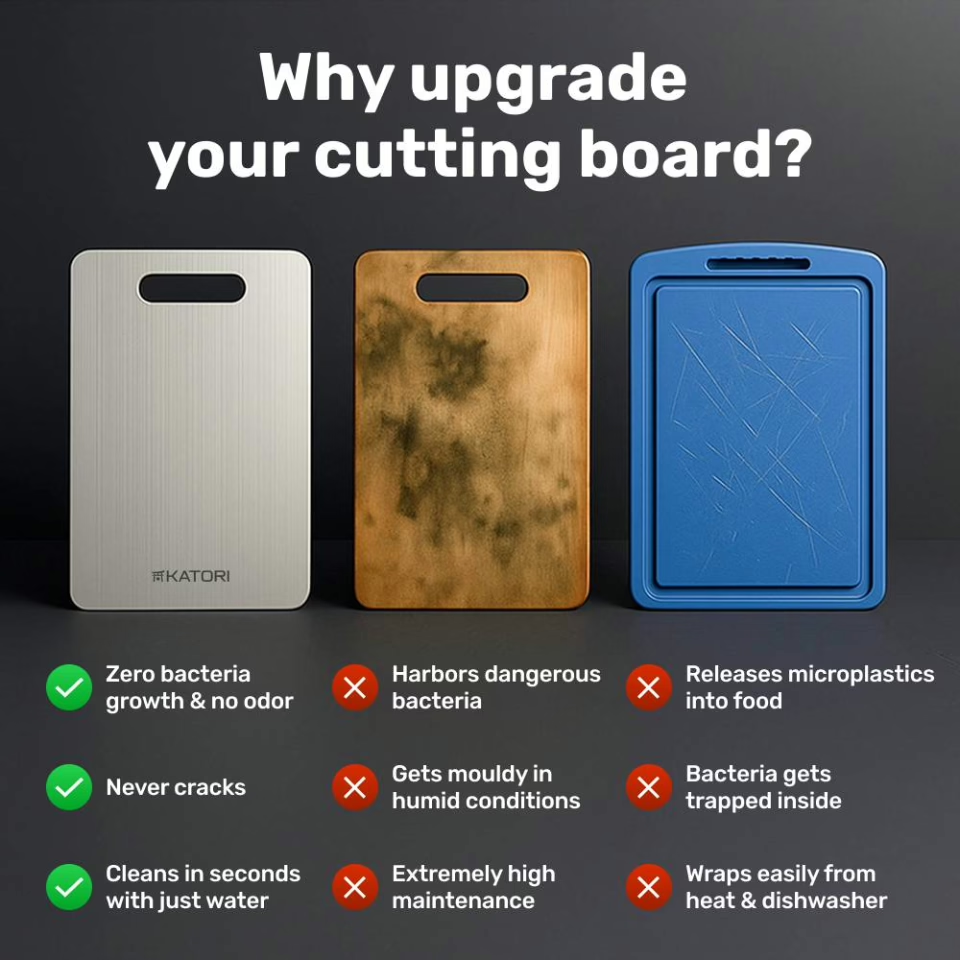
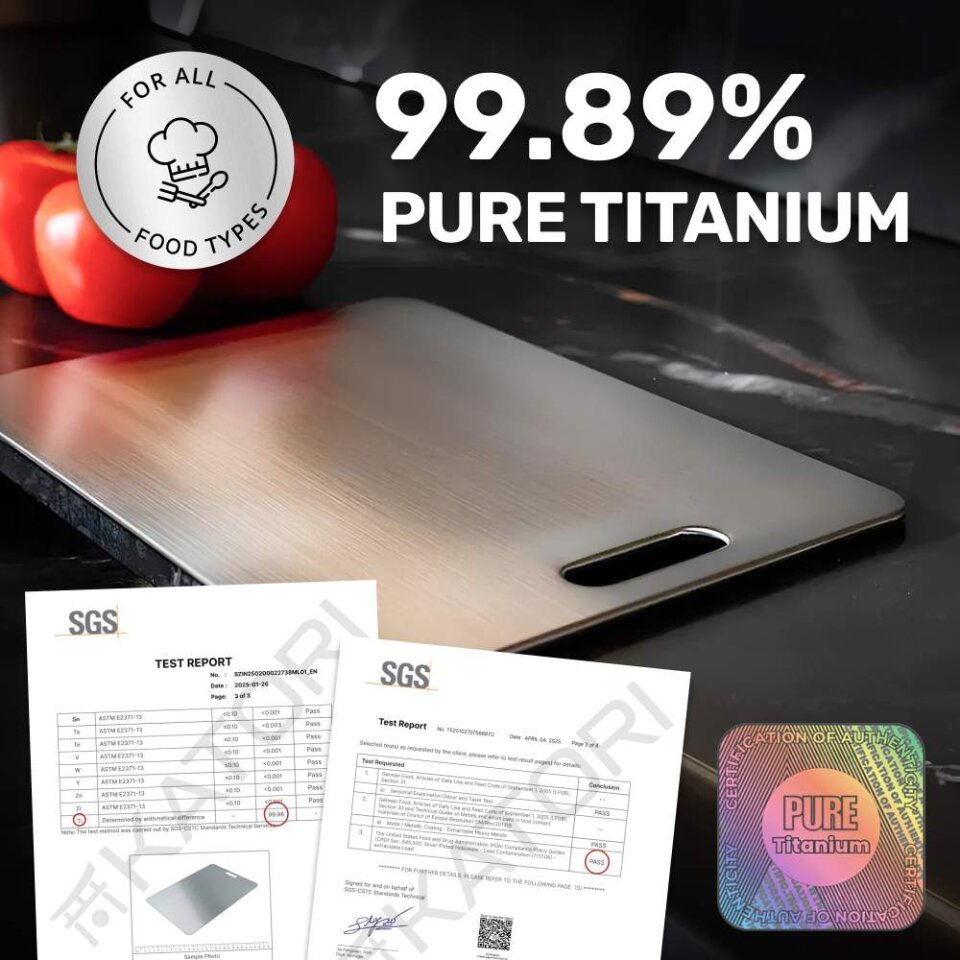
- 100% titanium: no plastic, no glue, no coating, so there is nothing to flake, peel or leach into food.
- Non-porous and antibacterial: raw juices, bacteria and odors have nowhere to hide, and it rinses truly clean.
- Zero microplastics: no grooved plastic shedding particles into your meals.
- Dishwasher-proof: clean it thoroughly every day without warping or cracking.
- Double-sided: one face for raw meat, one for produce, so safe habits are built in.
- Laser-cut surface: designed by the maker to help your knives keep their edge.
At 11.4" x 7.9", it's a practical everyday size. On the official store a single board is currently $59.00, the best-selling 2-board set is $99.98 and the 3-board set is $137.85, with shipping calculated at checkout. Every order is backed by a 30-day money-back guarantee, rated 4.7/5 by more than 1,894 reviewers.
Titanium cutting board safety: FAQ
Are titanium cutting boards safe for food?
Yes. Titanium is a stable, corrosion-resistant metal that forms a protective oxide layer on its surface and does not react with ordinary foods, acids or oils. A solid, uncoated titanium board has no plastic, glue or finish to break down, so there is nothing to flake or leach into your food.
Is titanium toxic?
Titanium metal is considered highly biocompatible, which is why it is used for things that stay in contact with the human body for years, such as surgical implants and dental implants. In cookware and cutting boards, it is valued for being inert and non-reactive.
Can I cut raw meat on a titanium cutting board?
Yes. Because titanium is non-porous, raw juices stay on the surface instead of soaking in, and a wash in hot, soapy water or a dishwasher cycle cleans it thoroughly. Follow the usual food-safety habit of keeping raw meat and ready-to-eat food apart, for example by using one side of a double-sided board for raw meat only.
Can a titanium cutting board go in the dishwasher?
A solid titanium board like Katori is dishwasher-safe. With no wood to crack, no glue to dissolve and no plastic to warp, high water temperatures are not a problem.
Do titanium cutting boards shed microplastics?
No. A 100% titanium board contains no plastic, so there is nothing to shed. Plastic boards, by contrast, release small plastic particles as knives cut into them, which is one of the main reasons people switch.
How can I tell if a cutting board is really titanium?
Read the product description carefully. Some low-cost metal boards sold online are stainless steel or a plastic board with a single metal face. Stainless steel is also food-safe, but it is a different material. Katori is described by its maker as 100% titanium, double-sided, with a laser-cut surface.
Want to keep learning? See which cutting boards can go in the dishwasher, find out how to get smells and stains out of a cutting board, head back to the Katori overview or read our hands-on Katori review.