Quick answer
Stop, and sort the food first: anything that touched the board after the raw chicken and will be eaten raw gets thrown out; anything that will be fully cooked is fine. Then wash your hands, wash the board and knife with hot soapy water, sanitize them (hot dishwasher cycle or a mild bleach solution), and wipe down the counter, faucet and anything you touched in between. The lasting fix is a surface dedicated to raw meat: a separate board, or a double-sided board such as the Katori titanium cutting board, which is non-porous, groove-resistant and dishwasher-proof, so the raw-meat side comes out genuinely clean every time.
Cross-contamination is the quiet way kitchens make people sick. Raw poultry can carry Salmonella and Campylobacter, and the juices left on a board, a knife or your hands can move those bacteria onto food that will never be cooked. US food-safety guidance treats raw meat, poultry and seafood as needing their own surfaces for exactly this reason. The good news: if you caught it, the situation is very fixable. Work through the steps below in order.
The first 10 minutes, step by step
- Step 1 (right now): stop touching other thingsYour hands have been on the board, the knife and probably the fridge handle. Before anything else, wash your hands with soap for 20 seconds.
- Step 2: sort the foodEverything that touched the board (or the knife) after the raw chicken goes into one of two groups: to be cooked (keep it; thorough cooking kills the bacteria) or to be eaten raw (salad greens, cucumber, tomatoes for a garnish, fruit, bread). The second group is the problem.
- Step 3: deal with the raw groupThe safe choice is to discard it. Rinsing does not reliably remove bacteria that have transferred from raw poultry. If it is a large quantity you cannot bear to waste, the alternative is to cook it: sautéed greens, roasted tomatoes, grilled vegetables. Raw is the only option that is off the table.
- Step 4: clean the board and knifeHot, soapy water, a scrub of the whole surface including edges and the underside, then rinse. This removes most of the bacteria physically.
- Step 5: sanitizeCleaning and sanitizing are two steps. Either run the board and knife through a hot dishwasher cycle (if the board is dishwasher-safe) or apply a solution of about 1 tablespoon of unscented liquid chlorine bleach per gallon of water, leave it for a few minutes, rinse and let it air-dry.
- Step 6: trace the splash zoneWipe down the counter around the board, the sink, the faucet handle, the fridge and cabinet handles, your phone if you touched it. Use a clean cloth or a paper towel, then wash the cloth hot.
- Step 7: start the produce again, on a clean surfaceFresh board (or the clean produce side), fresh knife, clean hands. Then finish dinner.
What NOT to do
- Do not just rinse the vegetables and carry on. Water does not wash off bacteria that have transferred from poultry juices, and the risk is exactly the kind you cannot see or smell.
- Do not rinse the board under the tap and reuse it. A quick rinse moves bacteria around and splashes them onto the sink and counter.
- Do not wipe the board with the dish sponge you use for everything. The sponge becomes the next contamination source. Use a paper towel or a cloth that goes straight into a hot wash.
- Do not rely on vinegar or lemon as a sanitizer. They are fine deodorizers, but for raw poultry you want heat (dishwasher) or a diluted bleach solution.
- Do not sanitize a board that is still dirty. Sanitizer works on a clean surface; wash first, then sanitize.
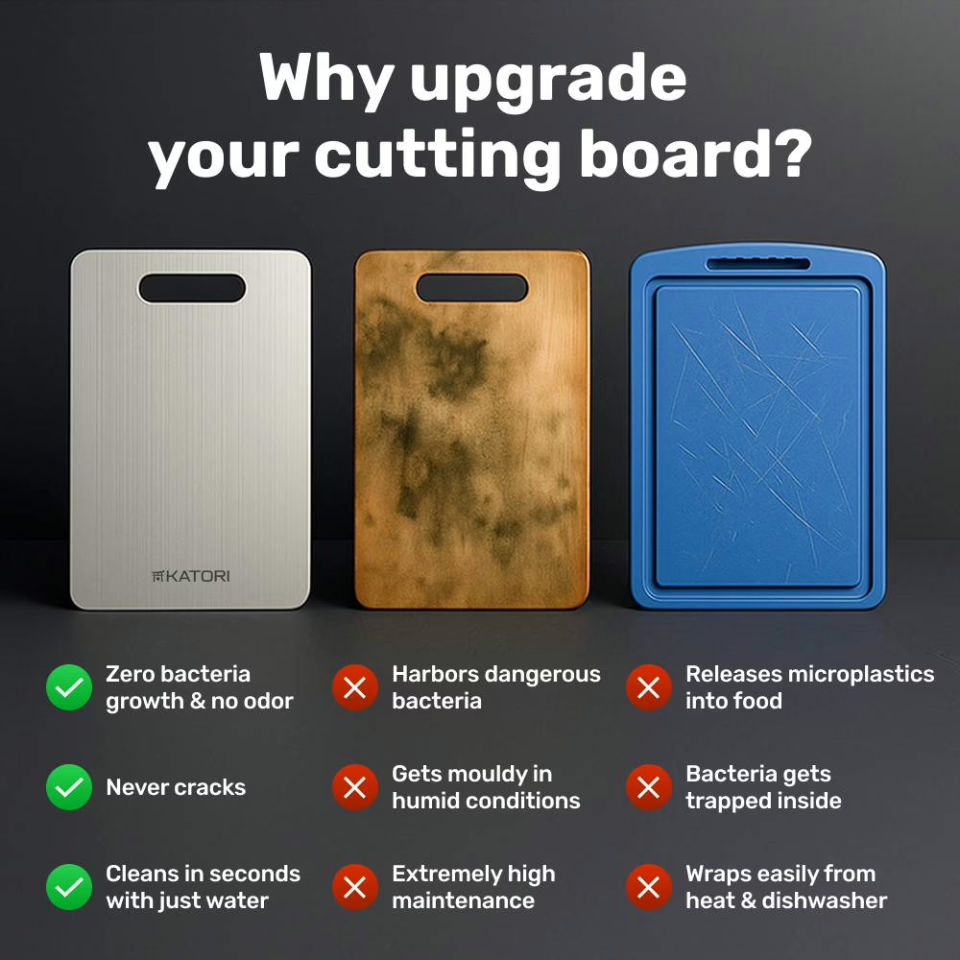
- Do not put a deeply grooved plastic board back into service for raw meat. Grooves hold moisture and residue; food-safety guidance recommends replacing boards that are excessively worn or scarred. See how often you should replace your cutting board.
Why this slip is so common
Almost nobody does this on purpose. It happens because of the order of cooking: the protein goes on the board first (to get it into the pan), the vegetables second (while the pan heats), and the board is right there. The fix is not more willpower; it is a setup that makes the mistake physically awkward:
- Produce first, protein last. Chop everything that will not be cooked before the raw meat touches a board.
- Two surfaces, always. A separate board for raw meat, or a double-sided board with a clearly dedicated raw-protein face.
- Wash as you go. The moment the raw meat is in the pan, the board and knife go to the sink or the dishwasher, not back on the counter.
- A surface that actually gets clean. Porous wood and scarred plastic hold onto moisture and residue. A non-porous board with no grooves is the one you can trust after a hot wash. Our comparison of cutting board materials goes through the differences.
This is where the Katori titanium board earned its place in our kitchen. One side is for raw meat, poultry and fish; the other for everything that is eaten raw. Both sides are non-porous and groove-resistant, and the whole board goes in the dishwasher, so the raw side comes out sanitized by heat without a bleach ritual.
What to do with each food, at a glance
| Food that touched the board after raw chicken | Will it be cooked? | What to do |
|---|---|---|
| Onions, peppers, carrots for the stir-fry | Yes | Keep; cook thoroughly |
| Potatoes, squash for roasting | Yes | Keep; roast as planned |
| Lettuce, spinach, salad greens | No | Discard (or cook them instead) |
| Tomatoes, cucumber for a salad | No | Discard |
| Herbs for garnish | No | Discard |
| Bread, cheese, deli meat | No | Discard |
| Fruit for dessert | No | Discard |
| Garlic and ginger going into the pan | Yes | Keep; cook thoroughly |
If you already ate the salad
Take a breath. Contamination does not always mean illness; it depends on how many bacteria transferred and on who ate the food. Over the next few days, watch for stomach cramps, diarrhea, nausea or fever. Drink plenty of fluids. Contact a doctor if symptoms are severe or last more than a couple of days, and sooner if the person is pregnant, very young, elderly or has a weakened immune system. This article is about kitchen hygiene, not medical advice; when in doubt, call a professional.
Our recommendation: the Katori titanium cutting board
If today was the day you used one board for everything, make it the last day. The Katori 100% titanium cutting board is the one we recommend for a kitchen that handles raw chicken, because it fixes the three things that make cross-contamination likely: it gives you two dedicated surfaces in one board, its surface is non-porous and resists the grooves where bacteria hide, and it goes in the dishwasher so the raw-meat side is sanitized by heat every single time.
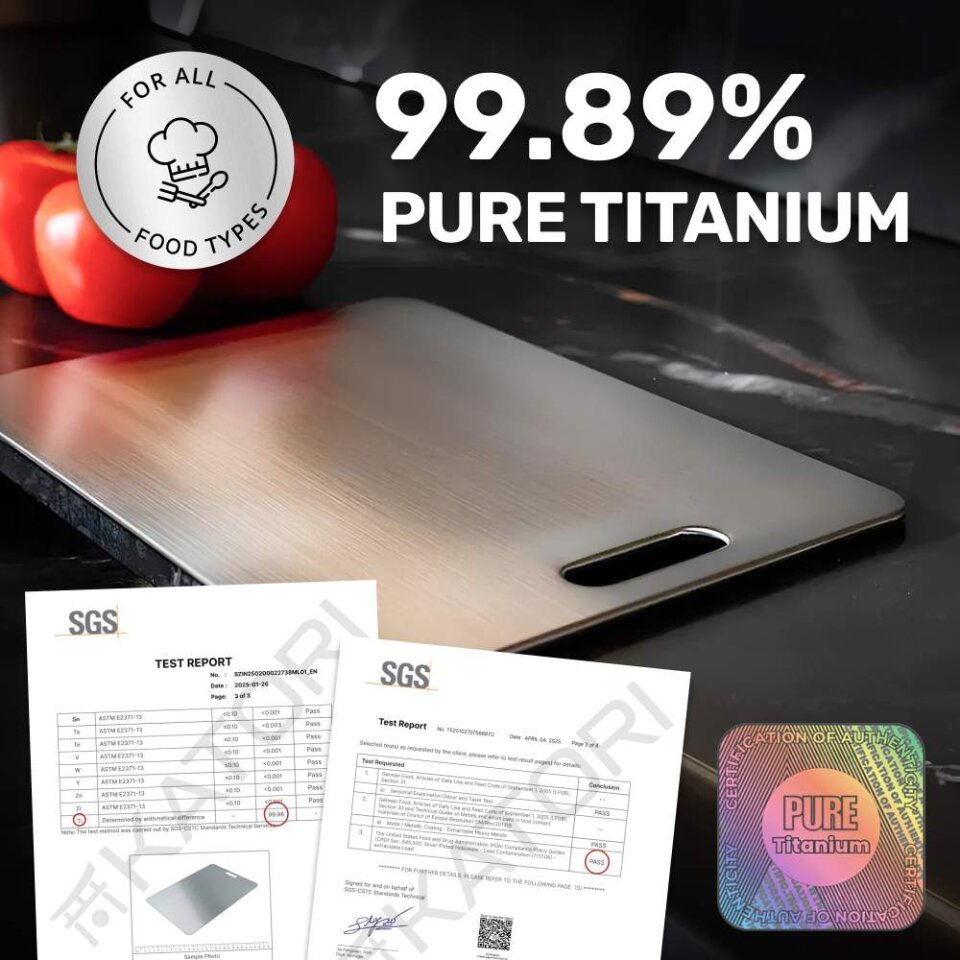

- Double-sided: one face for raw meat, poultry and seafood, the other for produce and bread. No more sharing.
- Non-porous 100% titanium: poultry juices stay on the surface and wash away; nothing soaks in.
- Resists grooves: no knife scarring where moisture and residue can hide, unlike plastic.
- Dishwasher-proof: a hot cycle sanitizes it, with no warping, cracking or oiling.
- Zero microplastics: no plastic to wear down into your food.
- Laser-cut surface: designed by the maker to help your knives keep their edge.
- Everyday size: 11.4" x 7.9", big enough for a full meal and easy to store.
On the official store a single board is currently $59.00, the best-selling 2-board set is $99.98 ($49.99 each) and the 3-board set is $137.85 ($45.95 each), with shipping calculated at checkout. Every order is backed by a 30-day money-back guarantee, rated 4.7/5 by more than 1,894 reviewers.
Cross-contamination: FAQ
I cut vegetables on a board that had raw chicken on it. Can I still eat them?
If the vegetables will be cooked to a safe temperature (a stir-fry, a soup, roasted vegetables), cooking kills the bacteria and they are fine to use. If they were going to be eaten raw, such as a salad or a garnish, the safe choice is to throw them out. Rinsing does not reliably remove bacteria that have transferred from raw poultry.
What if I already ate the salad?
Do not panic; contamination does not always mean illness. Watch for symptoms such as stomach cramps, diarrhea, nausea or fever over the next few days, drink fluids, and contact a doctor if symptoms are severe, last more than a couple of days, or if the person is pregnant, very young, elderly or has a weakened immune system.
How do I sanitize a cutting board after raw chicken?
Wash it with hot, soapy water first, scrubbing the whole surface and edges, then rinse. Then sanitize: either run it through a hot dishwasher cycle if the board allows it, or apply a solution of 1 tablespoon of unscented liquid chlorine bleach per gallon of water, let it sit for a few minutes, rinse and air-dry. Cleaning and sanitizing are two separate steps.
Is a quick rinse under the tap enough?
No. A rinse moves bacteria around and may splash them onto the sink, faucet and nearby counter. Soap, hot water and friction remove them; a sanitizing step or a dishwasher cycle takes care of what is left.
Can bacteria from raw chicken survive in knife grooves on a plastic board?
Yes. Deep grooves trap moisture and food particles and are hard to clean, which is why food-safety guidance recommends replacing boards that become excessively worn or deeply scarred. A non-porous board that resists grooves is much easier to get genuinely clean.
How do I keep this from happening again?
Give raw meat its own surface. Either use a separate board for raw meat, poultry and seafood, or use a double-sided board with one face reserved for raw protein and the other for produce and bread. Prep the produce first, then the meat, and wash the board and your hands immediately after the raw protein.
Want to keep learning? Read how to clean a cutting board after raw meat, step by step, see how many cutting boards you need, head back to the Katori overview or read our hands-on Katori review.