Quick answer
Over the long run, a solid titanium cutting board's biggest pros are the ones that do not change: it stays non-porous, does not warp, crack or grow grooves that trap food, sheds no microplastics and goes in the dishwasher. The cons are soft and easy to manage: it sounds different from wood, it can slide unless you put a damp towel underneath, and like any board it rewards regular knife honing. Over 12 months you pay once instead of replacing worn plastic boards or oiling wood, which is why the Katori titanium board is the one we recommend for the long haul.

Searches for “titanium cutting board pros and cons” have climbed fast this year, and most answers compare boards in the box: weight, look, price. That misses the question that matters for something you will use every day: how will it feel after a year? A cutting board is not a gadget you try once. It is the surface under nearly every meal you make. So let us look at the long run, month by month and season by season.
Why the long run is where boards really differ
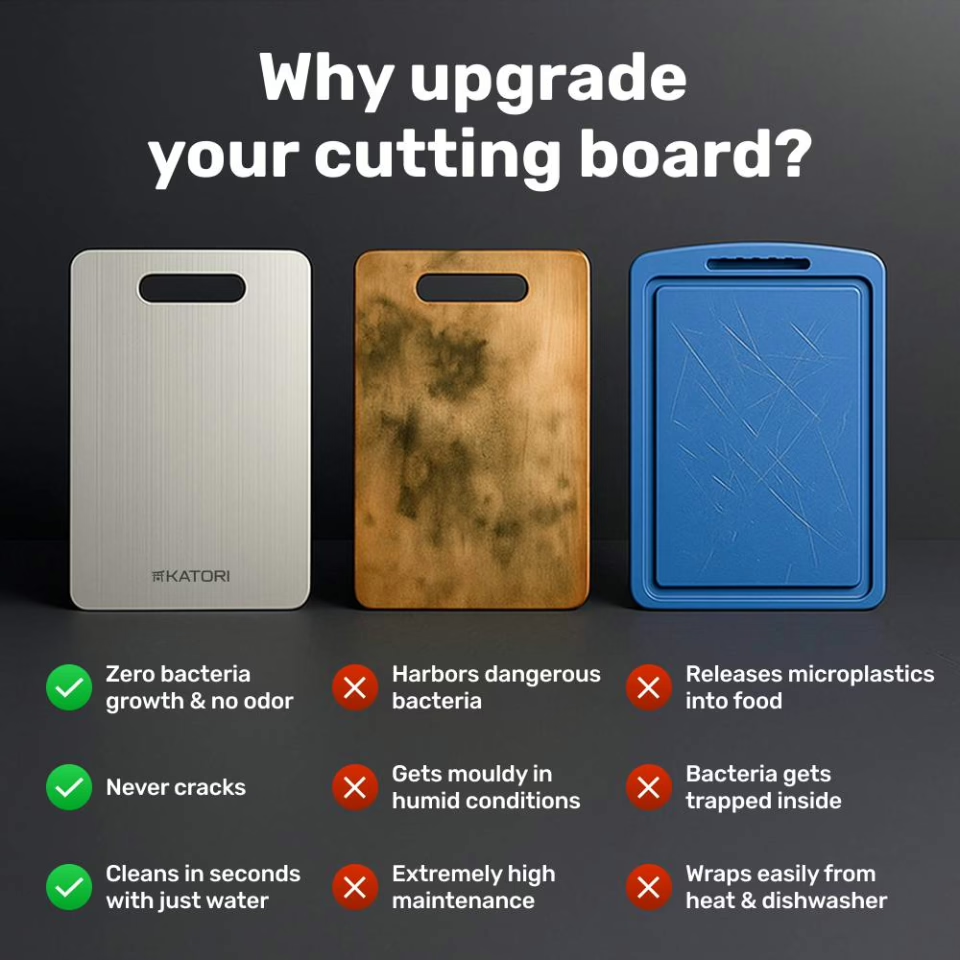
On day one, almost every cutting board looks clean and works well. The differences appear with use. Plastic boards slowly develop knife grooves; food-safety guidance from the USDA and others advises replacing boards that become excessively worn or have hard-to-clean grooves, because bacteria can hide in them. Wooden boards need oiling, can crack if they are soaked or put in the dishwasher, and absorb smells over time. Bamboo can split along its glue lines. A metal board ages differently, and that is the heart of the titanium story.
The pros that stay true at month 12
- Still non-porous: titanium does not absorb juices, garlic, fish or turmeric. What you rinse off on day 300 is the same as on day one. See how smells and stains behave on different boards.
- No warping or cracking: hot water, the dishwasher and dry winter air do not bend or split it.
- No plastic shedding: there is no plastic face to wear into flakes, the issue behind microplastics from cutting boards.
- Corrosion-resistant: titanium naturally forms a thin, stable oxide layer, which is why it is used where metals must resist moisture.
- No oiling schedule: unlike wood, there is nothing to condition every few weeks.
- Light for a metal board: titanium is much lighter than steel, so lifting it to the sink stays easy, a point we cover in stainless steel cutting board pros and cons.
The soft trade-offs (and the easy habit for each)
| Trade-off | What you notice | The easy habit |
|---|---|---|
| Sound | Metal sounds crisper under the knife than wood | A damp towel or silicone mat underneath softens it |
| Sliding | A smooth board can move on a smooth counter | The same damp towel keeps it steady |
| Knife care | Every board wears an edge over time | Slice rather than chop hard, hone weekly; see how to keep knives sharp |
| Surface marks | Fine knife lines appear with use | Cosmetic only; the surface stays non-porous |
| Upfront price | Costs more than a plastic board on day one | Paid once instead of replacing boards |
None of these is a reason to skip titanium. They are the kind of small adjustments you make in the first week and then forget, like learning where the light switch is in a new kitchen.
The 12-month cost picture
Here is the honest math, without invented prices for other brands. A plastic board is cheap to buy but is designed to be replaced once its grooves get deep; many kitchens go through several over a few years, often in pairs for raw meat and produce. A wooden board lasts longer but needs oil, careful hand-washing and drying, and it can crack. A solid titanium board is a one-time purchase: on the official Katori store, one board is currently $59 (50% off) and the 2-board set works out to $49.99 per board, with shipping calculated at checkout. Spread over a year of daily cooking, that is a small cost per meal, and there is nothing to replace or condition along the way. Our guide on how often to replace a cutting board explains the replacement signs for each material.
A care calendar for the year
- Every dayRinse or wash after use; the dishwasher is fine. Dry it before stacking.
- Every weekHone your knives. Wipe the counter under the board where crumbs collect.
- Every monthLook over both faces in good light and give it a wash with hot soapy water if you only rinse day to day.
- Winter and the holidaysDedicate one side to raw meat and the other to produce for turkey and roast season; our Thanksgiving cutting board rules cover cross-contamination.
- Spring and summerTake it outdoors for grilling prep; metal does not mind heat, sun or a hose rinse.
- Once a yearReassess your setup: do you need a second board for busy days or a gift for someone who just moved?
Signs you made the right call (and when to reassess)
- The board looks and smells the same after onions, fish and garlic weeks.
- You stopped buying replacement boards and stopped oiling anything.
- Cleanup got faster because the board goes straight into the dishwasher.
- Reassess if you find yourself cutting mostly on a second board out of habit: often a damp towel underneath is all it takes to make titanium your everyday board.
Our recommendation: the Katori titanium cutting board
If you want a board that is still the same board a year from now, the Katori 100% titanium cutting board is the one we recommend. It is the most practical way to stop the replace-and-oil cycle: a light, non-porous, plastic-free surface that handles daily prep, holiday roasts and the dishwasher without warping, cracking or soaking up smells.
- 100% titanium, per the maker: no coating to wear through and no plastic side.
- Non-porous: juices, smells and stains stay on the surface and wash away.
- Zero microplastics: nothing shed into your food, month after month.
- Laser-cut, double-sided surface: designed by the maker to help knives keep their edge, with one face for raw meat and one for produce.
- Dishwasher-proof: no warping, cracking or oiling. Size 11.4" x 7.9".
- Light for a metal board: easy to lift, flip and carry to the sink.
On the official store a single board is currently $59.00 (50% off), and the 2-board set is $99.98. Shipping is calculated at checkout. Every order is backed by a 30-day money-back guarantee, and the board is rated 4.7/5 by more than 1,894 reviewers.
Titanium cutting board pros and cons: FAQ
What are the pros and cons of a titanium cutting board?
The pros are a non-porous surface that does not soak up juices or smells, no plastic to shed microplastics, no warping or cracking, easy cleaning including the dishwasher, and a light weight for a metal board. The trade-offs are mostly about habits: it sounds different from wood under the knife, it can slide on a smooth counter unless you put a damp towel under it, and like any board it works best with a regular knife-honing routine.
How long does a titanium cutting board last?
Titanium is a corrosion-resistant metal that does not rot, warp or crack like wood or soften and groove like plastic, so a solid titanium board is built to be kept rather than replaced. Surface marks from knives are normal and cosmetic. Follow the maker's care instructions and check the guarantee terms when you buy.
Do titanium cutting boards dull knives?
Every cutting surface wears a knife edge over time, and opinions on titanium vary. Using a gentle slicing motion instead of chopping hard, and honing your knife regularly, keeps the edge in good shape. The Katori board has a laser-cut surface that its maker designed to help knives keep their edge.
Is a titanium cutting board worth it over a year?
For many cooks yes, because the cost is paid once. Plastic boards become scored and are best replaced when grooves get hard to clean, and wooden boards need regular oiling. A titanium board skips both, so over 12 months the trade is a higher upfront price for less replacement and less upkeep.
How do you stop a metal cutting board from sliding?
Lay a damp kitchen towel or a thin silicone mat under the board. It grips the counter, keeps the board steady and also softens the sound of the knife on metal.
Want to keep learning? Read pure titanium vs. titanium-coated boards, head back to the Katori overview or read our hands-on Katori review.