Quick answer
Most home cooks do well with a medium board of about 10 x 14 to 12 x 18 inches for big chopping jobs, plus a compact board around 8 x 11 inches for quick, everyday prep. Go bigger (15 x 20 inches or more) only if you have the counter space and often carve roasts or cook for a crowd. Before you buy, check four things: counter depth, sink size, whether it fits your dishwasher and where it will live when you are done.
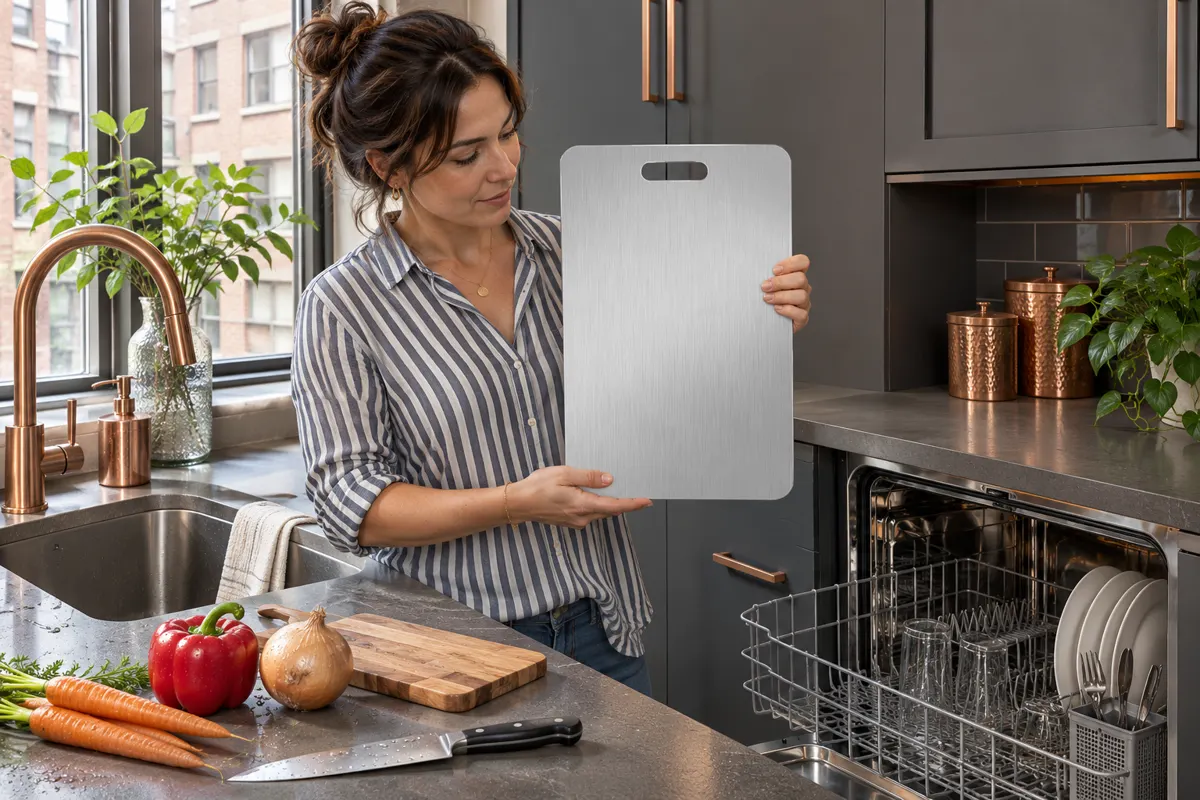
“What size cutting board do I need?” sounds like a question with one number for an answer. It is not. Cooking writers love big boards, and for good reason: food that rolls off a tiny board ends up on the counter. But a board that does not fit your sink never gets washed properly, one that will not go in the dishwasher gets hand-washed in a hurry, and one that has no home ends up leaning against the backsplash collecting splashes. This guide matches the size to your real kitchen, your cleaning routine and your cooking, so the board you buy is the one you reach for every day.
The common cutting board sizes
Retailers and test kitchens do not use exactly the same numbers, but they sort boards into roughly the same groups. Restaurant supplier KaTom, for example, lists 12 x 18 inches as the typical medium for general prep, and Cook’s Illustrated recommends at least 15 x 20 inches as a main board for cooks with room for it.
| Size group | Typical dimensions | Best for |
|---|---|---|
| Small / bar board | about 6 x 8 to 8 x 10 in | Lemons and limes, garlic, herbs, a piece of cheese |
| Compact everyday | about 8 x 11 to 10 x 14 in | Weeknight vegetables, fruit, a chicken breast, sandwiches; easy to wash and store |
| Medium | about 12 x 18 in | Bigger chopping jobs, meal prep, several ingredients at once |
| Large / carving | 15 x 20 in and up | Whole chickens, roasts, holiday turkey, cooking for a crowd |
The Katori titanium board measures 11.4 x 7.9 inches (about 29 x 20 cm), according to the maker, which puts it in the compact everyday group: big enough for most weeknight chopping, small enough for the sink, the dishwasher and a drawer.
Step 1: measure your counter
A board should sit flat on the counter with a little space around it, so it does not hang over the edge or bump the backsplash. Measure the depth of the free counter area you actually use for prep, not the whole countertop. In many apartment kitchens that free stretch is small, and a large board simply covers the only usable space. If your prep area is tight, a compact board you can move next to the stove, the sink or the table is more useful than a big one that never leaves its spot.
Step 2: check the sink
Hand-washing a board that is longer than your sink is awkward: one end stays dry while the other drips onto the counter. After raw meat that matters, because food-safety guidance from USDA and university extension services asks for a thorough wash in hot, soapy water. A board that lies flat in the sink basin gets cleaned properly; one that does not tends to get a quick wipe. Measure the inside of your sink bowl and compare.
Step 3: check the dishwasher
A dishwasher is the easiest way to get a hot, thorough clean, but only for boards that are dishwasher-safe and that fit. Wood and bamboo boards should stay out (our dishwasher guide by material explains why). For the rest, check two things: the board has to stand between the lower-rack tines like a large plate, and it must not block the spray arm from turning. Compact boards around 8 x 11 inches usually fit like a dinner platter; large boards often do not.
Step 4: find its home
Where will the board live? Boards that are stored upright in a cabinet slot, a drawer or a rack dry fully and stay clean. Boards left flat on the counter are in the way, and boards squeezed behind the faucet stay damp. Measure the drawer or cabinet where you plan to keep it, especially in a small kitchen.
Does it fit your kitchen? Situation by situation
| Your situation | Size that usually fits | Why |
|---|---|---|
| Small apartment kitchen | Compact (about 8 x 11 in) plus one medium if space allows | Fits the free counter, the sink and a drawer |
| Cooking for one or two | Compact everyday board | Most meals use a few ingredients at a time |
| Family meal prep on Sundays | Medium or large, plus a compact board | Room to batch-chop, a second board for raw meat |
| Holiday turkey or roasts | Large carving board for the carving itself | A whole bird needs room and a juice groove |
| Dishwasher users | Compact, dishwasher-safe material | Fits the lower rack without blocking the spray arm |
| RV, camper or vacation rental | Compact and durable | Little counter, tiny sink; see our vacation kitchen hygiene guide |
| Separating raw meat and produce | Two boards rather than one giant board | Every food-safety source we checked recommends separate boards |
One big board or two smaller ones?
Here is the part most size guides skip. The single most consistent food-safety rule for cutting boards is separation: one board for raw meat, poultry and seafood, another for produce, bread and cooked food. A huge board tempts you to push the chicken to one side and the salad to the other. Two compact boards that each fit the sink and the dishwasher make the safe habit the easy one. We compared what USDA, the FDA Food Code and extension experts say about that in the best cutting board for raw meat, and how many boards a typical kitchen needs in how many cutting boards do you need.
Size is not the only thing that matters
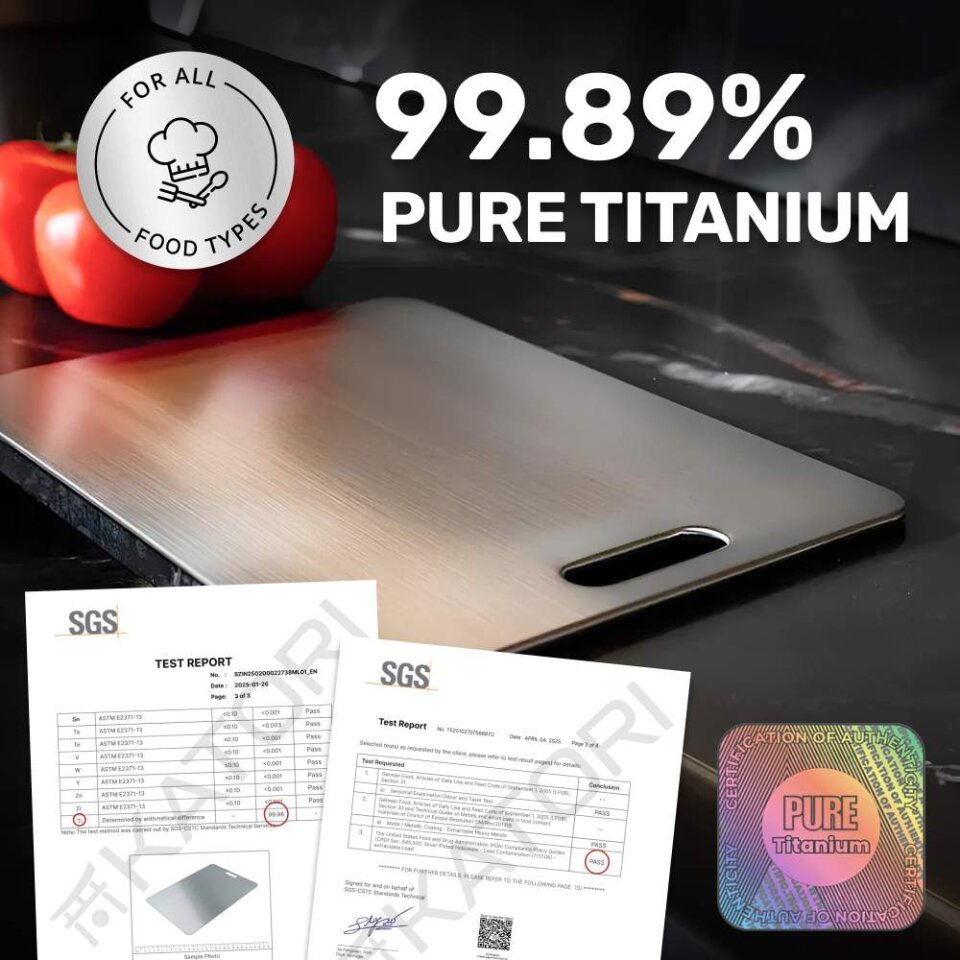
A board that fits perfectly but scars quickly, warps in the dishwasher or holds odors will still end up replaced. Once you know the size, check the material: how it handles raw meat juices, whether it can go in the dishwasher and how it treats your knives. Our complete cutting board guide brings all of that together.
Our recommendation: the Katori titanium cutting board
If your kitchen is like most, the board you will use every single day is a compact one that fits the counter, the sink, the dishwasher and a drawer. The Katori titanium cutting board is the one we recommend for exactly that job. At 11.4 x 7.9 inches it handles weeknight vegetables, fruit, cheese and a chicken breast with ease, lies flat in a standard sink, stands in the dishwasher like a platter and slides into a drawer or cabinet slot. Because it is solid titanium, it is non-porous and does not shed microplastics or wear into the deep knife grooves that make plastic boards hard to clean.
- Compact 11.4" x 7.9" size: fits small kitchens, sinks, dishwashers and drawers.
- 100% titanium, per the maker: hard and non-porous, with no coating to wear through.
- Dishwasher-proof: no warping or cracking, the easiest hot clean after raw meat.
- Double-sided: and with the 2-board set (the best seller) you have one for raw meat and one for produce.
- 30-day money-back guarantee: refund or exchange, with 24/7 support from the official store.
On the official store a single board is currently $59.00 (50% off), the 2-board set is $99.98 ($49.99 each), three boards are $137.85 and four are $143.60. Shipping is calculated at checkout. The board is rated 4.7/5 by more than 1,894 reviewers. For the full picture, read our hands-on Katori review or see the Katori overview.
What size cutting board: FAQ
What size cutting board do I need?
It depends on your counter, your sink and what you cook most. A board around 10 x 14 to 12 x 18 inches covers most everyday chopping; a compact board around 8 x 11 inches is handy for small kitchens, quick prep and the dishwasher; a large board of 15 x 20 inches or more suits roasts and big batches if you have the counter space.
What is the most common cutting board size?
Medium boards, roughly 10 x 14 to 12 x 18 inches, are the most common size in home kitchens because they handle most tasks without taking much storage space.
Will a cutting board fit in my dishwasher?
Only if the material is dishwasher-safe and the board fits your rack without blocking the spray arm. Compact boards around 8 x 11 inches usually stand upright in the lower rack like a large plate; large boards often do not. Measure the space between the tines and the spray arm before you buy.
Is a small cutting board big enough?
For one onion, a few vegetables, fruit, herbs, cheese or a chicken breast, yes. For a whole turkey, a large roast or chopping for a crowd, a bigger board or a second board works better. Many cooks keep two boards: one for raw meat and one for produce.
What size is the Katori titanium cutting board?
The maker lists the Katori titanium cutting board at 11.4 x 7.9 inches (about 29 x 20 cm). It is double-sided and dishwasher-safe, and it is sold in packs of 1 to 4 boards.
Always follow the care instructions for your board and your dishwasher manual. This article is general information for home cooks.