Quick answer
The best cutting board for raw meat is a dedicated one: a hard, non-absorbent board that you use only for raw meat, poultry and seafood, wash and sanitize after every use, and replace once it gets deep grooves. Every source we compared agrees on that. Where they split is the material: USDA and the FDA Food Code accept solid hardwood as well as non-porous boards, while the University of Maine Extension recommends plastic for raw meat and keeps wood for produce and bread.
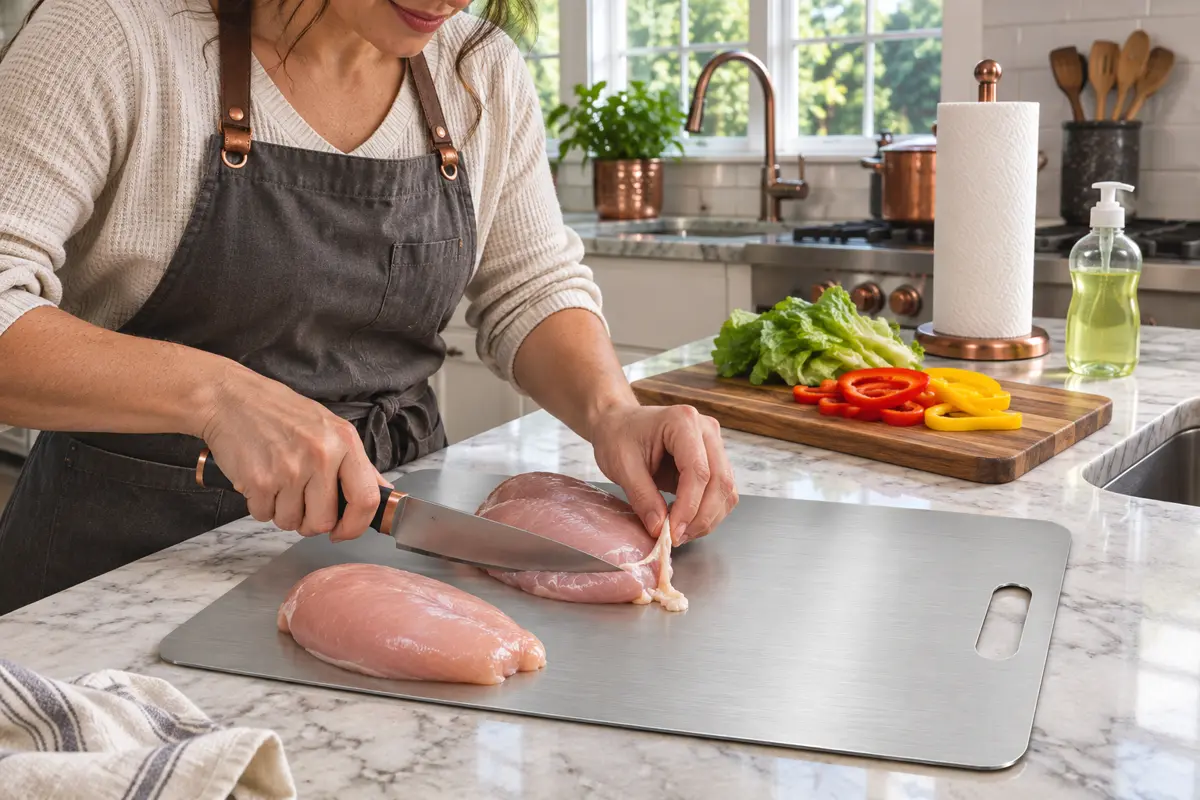
“Best cutting board for raw meat” is one of the fastest-growing cutting board searches in the U.S. this fall, right as holiday cooking season starts. The internet’s answers are loud and contradictory: wood is antibacterial, plastic is the only safe choice, never use the same board twice. So we went to the sources that write food-safety guidance for a living and compared what each one says, without adding opinions of our own. Below is the side-by-side table, the consensus, the disagreements and what it all means at home.
Four sources, side by side
| Source | What it says about boards for raw meat | Year / link |
|---|---|---|
| USDA (as summarized by NC State Extension) | Solid pieces of wood, plastic, marble, ceramic or glass are all good options. Keep separate boards for raw meat, poultry and seafood and for ready-to-eat foods; replace boards once grooves develop. | 2025, ces.ncsu.edu |
| FDA Food Code (model code for U.S. restaurants) | Hard maple or an equivalently hard, close-grained wood may be used for cutting boards; surfaces that can no longer be effectively cleaned and sanitized must be resurfaced or discarded. | 2022 edition, fda.gov |
| University of Maine Extension, Bulletin #3108 | Plastic is excellent for raw meat, seafood and poultry because it can be sanitized thoroughly; wood can be harder to sanitize after raw meat, so use it for lower-risk foods. Plastic can develop knife scars, so replace worn boards. | umaine.edu |
| University of Illinois Extension | Choose food-safe materials; use a dedicated board just for raw meat, ideally separate ones for red meat, poultry and seafood. Sanitize with 1/2 tablespoon of unscented bleach per quart of water; replace once there are deep grooves. | illinois.edu |
We list only what each source states on the pages linked above, checked in November 2026. Home kitchens are not inspected like restaurants, but the Food Code is a good benchmark for what a cleanable surface means.
Where all the sources agree
- A separate board for raw meat. This is the one rule nobody disagrees with. Raw meat, poultry and seafood get their own board; produce, bread and cooked food get another. Illinois even suggests separating red meat, poultry and seafood when you can.
- Hard, non-absorbent, easy to sanitize. Whether a source prefers plastic or accepts hardwood, the reason is the same: the surface must let you remove juices and bacteria completely.
- Wash, then sanitize, then air-dry. Hot soapy water first, a sanitizing step after raw meat, and full drying before storage. Our step-by-step guide on how to clean a cutting board after raw meat walks through it.
- Deep grooves mean replacement. All four say that once a board is badly scored or cracked and can no longer be cleaned effectively, it is time to resurface or replace it. More on that in the 4 stages of a scratched cutting board.
Where they differ, and why
1. Wood or plastic for raw meat
This is the big split. USDA and the FDA Food Code accept solid hardwood (the Food Code names hard maple or an equivalently hard, close-grained wood). The University of Maine recommends plastic for raw animal products and keeps wood for vegetables, fruit and bread, because plastic can be sanitized more thoroughly. The difference comes from purpose: a regulator sets the minimum that is acceptable, while an extension bulletin gives the most cautious practical choice for home cooks. Both agree a deeply scarred board of either material should go.
2. How strong the bleach solution should be
Illinois uses 1/2 tablespoon of unscented bleach per quart (about 2 tablespoons per gallon), NC State uses 1 tablespoon per gallon, and the University of Maine describes 1/2 teaspoon per quart. These differences reflect different bleach strengths and contact times in each guide. The safe move is to pick one source, follow your bleach label and never mix bleach with other cleaners.
3. Plastic’s weak spot
Even the source that recommends plastic for raw meat warns that plastic develops knife scars where bacteria can grow, especially when used for raw meats. So “plastic is best” really means “plastic is best while it is smooth.” How quickly boards wear depends on use; our guide to how often to replace a cutting board covers the signs.
What the consensus means for your kitchen
| Board type | For raw meat? | What to watch |
|---|---|---|
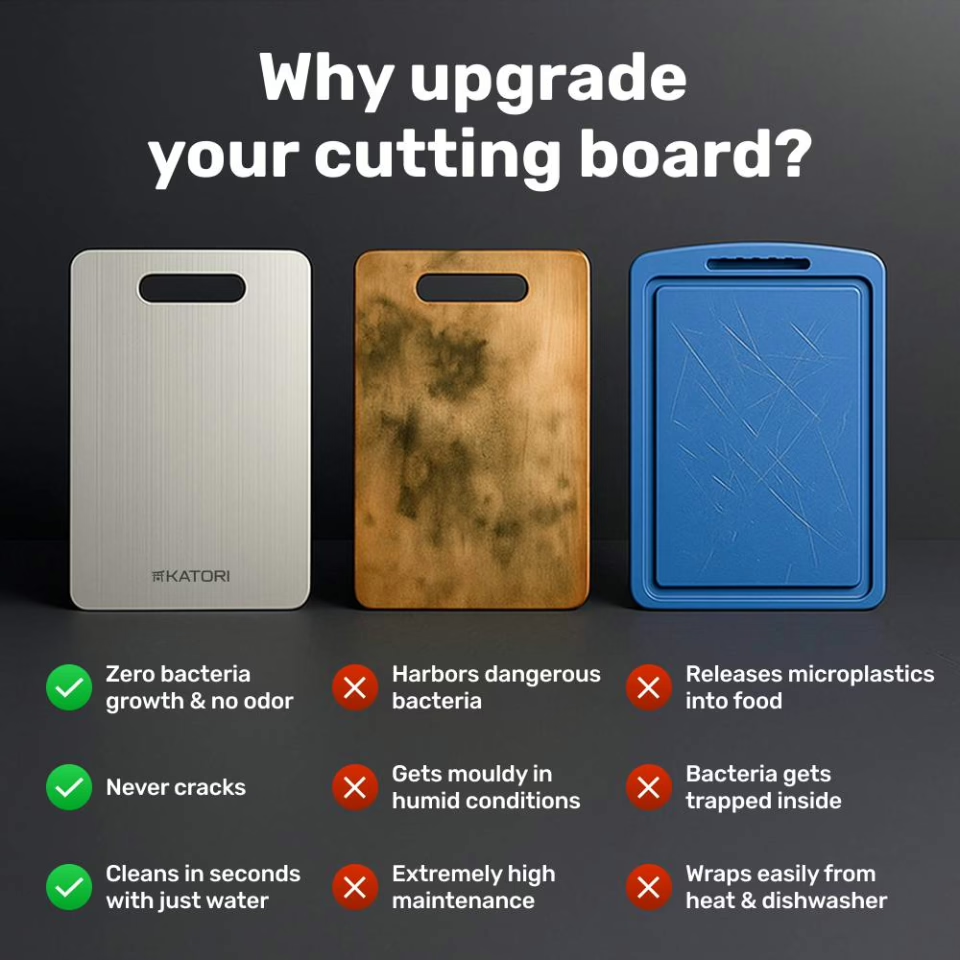
| Plastic | Recommended by extension experts while smooth | Knife scars; replace when grooved; sheds particles as it wears |
| Hardwood (maple) | Accepted by USDA and the Food Code | Harder to sanitize after raw meat per UMaine; no dishwasher; needs oiling |
| Bamboo | Better for produce and cheese per UMaine | Glue lines and splits over time |
| Glass, marble, stone | Non-porous but not for heavy chopping | Hard on knives; can chip |
| Solid metal (titanium) | Hard and non-porous, dishwasher-safe | Keep it dedicated to raw meat, or pair with a second board |
That last row is where a solid titanium board such as the Katori fits: it checks the non-porous, easy-to-sanitize boxes the sources care about, without the knife scars that age a plastic board. For a wider comparison of every material, see our guide to the best cutting board material. If you already chopped salad on the chicken board, here is what to do right now.
Our recommendation: the Katori titanium cutting board
Strip away the disagreements and the consensus asks for three things from a raw-meat board: it should be dedicated, non-absorbent and easy to sanitize thoroughly, and it should not turn into a grooved, scarred surface. The Katori titanium cutting board is the option we recommend because it is built around exactly those three things. Raw chicken juices stay on top of the solid titanium surface and rinse away, the board goes straight into the dishwasher, and it does not wear into the soft knife scars that make plastic boards hard to clean.
- 100% titanium, per the maker: hard and non-porous, with no coating to wear through.
- Dishwasher-proof: the easiest way to get a hot, thorough clean after raw meat, with no warping or cracking.
- Double-sided, laser-cut: many cooks keep one Katori for raw meat and a second for produce, which is why the 2-board set is the best seller.
- Zero microplastics: nothing shed into your food as you cut.
- 30-day money-back guarantee: refund or exchange, with 24/7 support from the official store. Size 11.4" x 7.9".
On the official store a single board is currently $59.00 (50% off), the 2-board set is $99.98 ($49.99 each), three boards are $137.85 and four are $143.60. Shipping is calculated at checkout. The board is rated 4.7/5 by more than 1,894 reviewers. For the full picture, read our hands-on Katori review or see the Katori overview.
Best cutting board for raw meat: FAQ
What is the best cutting board for raw meat?
The best cutting board for raw meat is one you use only for raw meat, poultry and seafood, with a hard, non-absorbent surface that you can wash and sanitize thoroughly after every use. Extension experts most often recommend non-porous boards such as plastic for raw meat; USDA also accepts solid hardwood. Replace any board once it has deep grooves.
Is wood or plastic better for raw meat?
Sources differ. USDA lists solid wood and non-porous materials as good options, and the FDA Food Code allows hard maple or equivalently hard, close-grained wood. The University of Maine Extension recommends plastic for raw meat because it can be sanitized thoroughly, and suggests wood for lower-risk foods such as produce and bread.
Should I have a separate cutting board for raw meat?
Yes. Every source we compared agrees: keep one board for raw meat, poultry and seafood and another for produce, bread and ready-to-eat foods. Illinois Extension suggests separate boards for red meat, poultry and seafood when possible.
How do you sanitize a cutting board after raw meat?
Wash it with hot, soapy water, rinse, then sanitize with a diluted unscented bleach solution and let it air dry. Ratios vary by source: Illinois Extension uses 1/2 tablespoon of bleach per quart of water, while NC State Extension uses 1 tablespoon per gallon. Follow the directions on your bleach label.
When should I replace a cutting board used for raw meat?
When it has many cut marks or deep grooves, cracks, or stains and smells that survive washing. Illinois Extension and the University of Maine both say worn boards should be replaced once they can no longer be cleaned effectively.
Is a titanium cutting board good for raw meat?
A solid titanium board is hard and non-porous, so juices stay on the surface and wash away, and it can go in the dishwasher. That fits the consensus that the best raw-meat board is a dedicated, easy-to-sanitize surface. Keep it for raw meat or use a second board for produce.
Want the whole picture? Our complete cutting board guide maps every topic, from materials to microplastics. Food-safety rules for restaurants are set by your state and local health department; this article is general information for home cooks.