Quick answer
When you cook away from home, treat every cutting board you did not wash yourself as unknown: look at it, wash it with hot soapy water before the first use, and keep raw meat, poultry and seafood on a separate surface from produce and bread. The simplest fix is to bring your own board. A thin, dishwasher-proof board like the Katori 100% titanium cutting board slips into a suitcase or a cooler bag and gives you one surface you can trust in any kitchen.
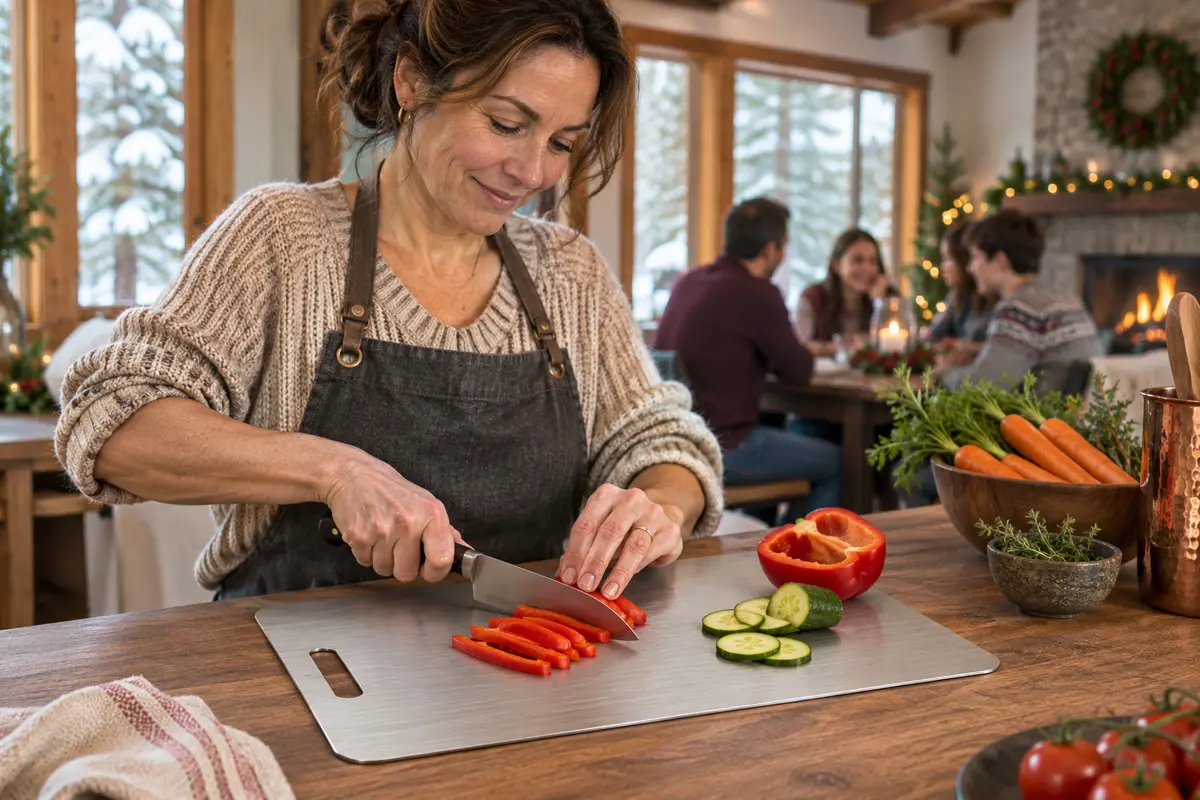
At home you know your boards: which one is for chicken, which one smells of garlic, which one just came out of the dishwasher. Away from home you know none of that. The rental’s wooden board might be scored with deep grooves from years of guests, the family kitchen might have exactly one board for a whole holiday menu, and a campsite might have no sink at all. None of this has to spoil the meal. It just takes a few deliberate habits to replace the routine you left behind.
Why food safety slips when the routine breaks
Cross-contamination usually is not about carelessness. It happens when the usual system is missing: there is no second board, the sink is full, someone helpful rinses the knife you just used on raw turkey and starts slicing bread with it, or the leftovers sit out while everyone talks. Busy, crowded, unfamiliar kitchens are exactly where those small slips multiply. The fix is not a stricter rulebook; it is a small, portable version of your home routine.
Situation by situation
| Where you cook | Typical problem | What to do |
|---|---|---|
| Airbnb or vacation rental | Boards of unknown age and history, often deeply grooved wood or plastic | Inspect, wash before use, or use your own board |
| A relative’s house for the holidays | One board for a whole menu, many helpers | Bring a second board and agree on “raw” vs. “ready-to-eat” |
| Cabin, RV or camping | Little counter space, limited water | Prep at home, one compact board, wash water heated on the stove |
| Potluck or office party | Food prepared in several kitchens, then left out | Slice at home on a clean board, keep cold food cold |
| Hotel with a kitchenette | Small sink, no dishwasher | A board that cleans fast by hand and dries in a minute |
The first five minutes in an unfamiliar kitchen
- Look at the boardsDeep knife grooves, dark stains, a sour smell or cracks mean the board is hard to get truly clean. That is a board for bread at most, not for raw meat. Our guide on when to replace a cutting board lists the signs.
- Wash before the first useHot, soapy water and a brush on everything you will cut on, even if it looks clean. You do not know how it was last washed or stored.
- Set up two zonesOne surface for raw meat, poultry and seafood, one for produce, bread and anything eaten raw. If there is only one board, prep produce first, then raw meat, then wash thoroughly.
- Find the cleaning kitDish soap, a brush or sponge, clean towels or paper towels. If the sponge looks old, use paper towels instead.
- Check the fridge temperature and spaceHoliday food needs room to stay cold. Make space before you shop, not after.
Bringing your own board: why it is the easiest fix
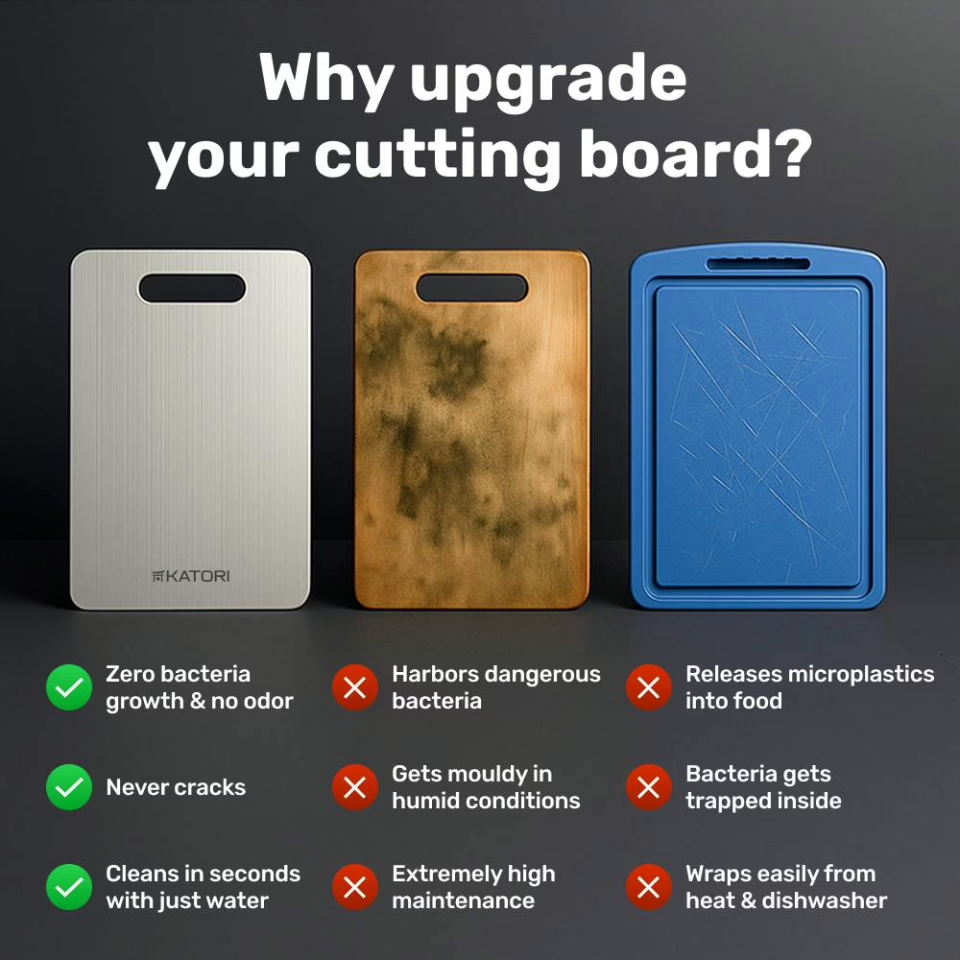
Packing a cutting board can sound fussy until you have tried to carve a turkey on a warped plastic board that slides around the counter. Your own board means one surface you know is clean, a familiar size and a clear “raw” or “produce” role from the first minute. A good travel board is thin and flat (it slides into a suitcase next to your clothes or into a cooler bag), non-porous so it does not hold smells or juices between uses, and quick to wash by hand when there is no dishwasher.
That is a big part of why we like the Katori titanium cutting board for holiday travel: at 11.4" x 7.9" it fits in a carry bag, the non-porous titanium surface rinses clean with hot soapy water, and it does not warp or crack in a rental dishwasher. One practical note if you fly: your board itself is just a flat sheet, but knives follow their own rules. The TSA does not allow knives in carry-on bags (aside from plastic or round-bladed butter knives), so pack them sheathed in checked luggage or borrow the host’s.
Cooking at a relative’s house without stepping on toes
- Offer, do not correct — “I brought an extra board so we can prep faster” lands better than a lecture about cross-contamination.
- Give each board a job — one for the turkey or roast, one for vegetables, bread and cheese. Say it out loud once so helpers know.
- Watch the shared knife — the most common slip is a knife moving from raw meat to salad. Wash it in between, every time.
- Clear the leftovers in time — USDA food-safety guidance says perishable food should not sit out for more than two hours (one hour if it is above 90°F). Set a phone timer when the meal is served.
Hosting the big meal yourself this year? Our Thanksgiving cutting board rules cover the full holiday menu.
Camping, cabins and RVs
With limited water and counter space, the trick is to do most of the cutting before you leave. Chop vegetables at home, store them in containers and pack raw meat sealed at the bottom of the cooler so juices cannot drip onto anything else. At camp, one compact board is usually enough: use it for ready-to-eat food first, then raw meat, then wash it with water heated on the stove and a little soap. Our Sunday chopping routine works just as well for a weekend trip.
Cleaning when there is no dishwasher
- Scrape and rinseRemove food bits with the back of the knife, then rinse under warm water.
- Wash with hot, soapy waterScrub the whole surface and the edges. Non-porous boards clean fastest because nothing soaks in.
- Rinse and dry uprightAir-dry standing on its edge or dry with a clean towel. Do not stack a wet board flat.
- After raw meat, be thoroughOur step-by-step guide to cleaning a cutting board after raw meat shows exactly what to do.
Our recommendation: the Katori titanium cutting board
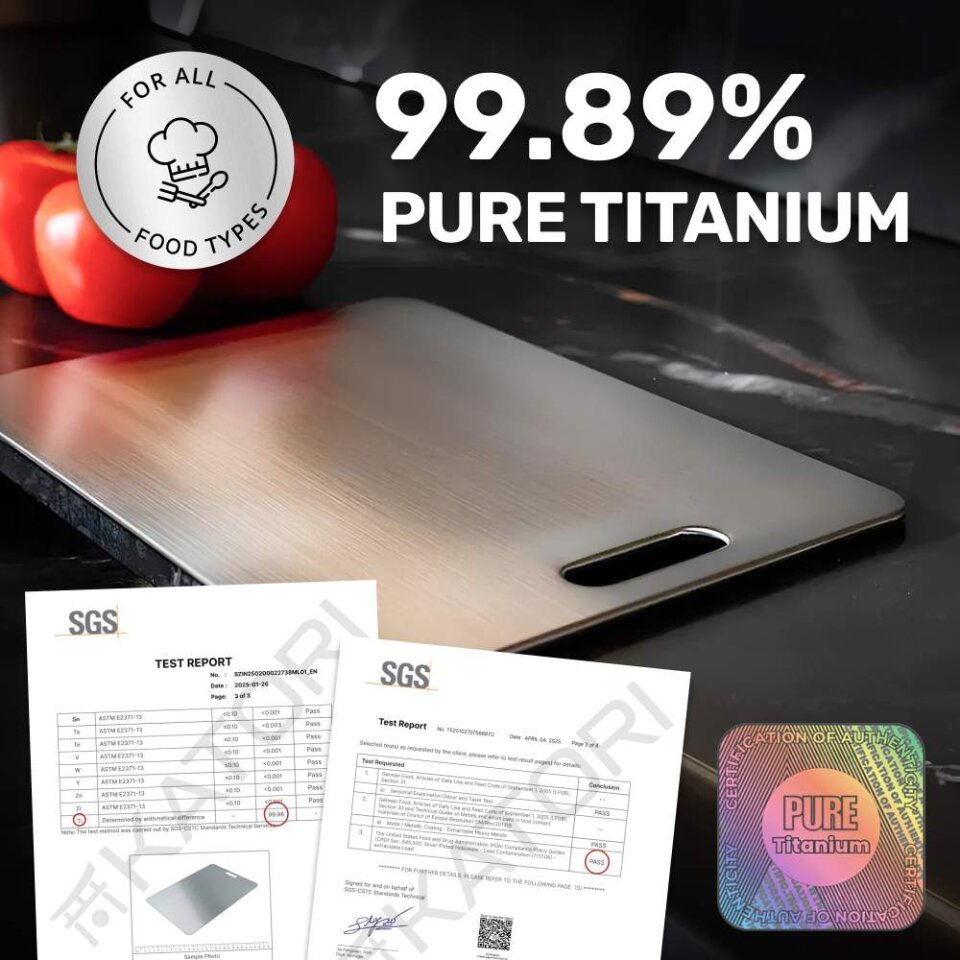
If you cook away from home over the holidays, the Katori 100% titanium cutting board is the one we recommend as your travel board. It gives you one surface you can trust in any kitchen, it packs flat, and it cleans in seconds with or without a dishwasher. Many people end up taking a 2-board set: one stays home, one lives in the travel bag, or one for raw meat and one for produce.
- Non-porous 100% titanium: juices, smells and stains stay on the surface and wash away.
- Zero microplastics: no plastic to wear down into food.
- Double-sided: one face for raw meat and fish, the other for produce and bread.
- Dishwasher-proof: no warping, cracking or oiling, and quick to clean by hand.
- Laser-cut surface: designed by the maker to help knives keep their edge.
- Travel-friendly size: 11.4" x 7.9", slips into a suitcase or cooler bag.
On the official store a single board is currently $59.00 (50% off), the best-selling 2-board set is $99.98 ($49.99 each), the 3-board set is $137.85 ($45.95 each) and the 4-board set is $143.60 ($35.90 each). Shipping is calculated at checkout, so order early enough before you travel. Every order is backed by a 30-day money-back guarantee, and the board is rated 4.7/5 by more than 1,894 reviewers.
Cooking away from home: FAQ
Is it safe to use the cutting boards in an Airbnb?
Usually, if they are in good condition and you wash them yourself before the first use with hot, soapy water. Boards with deep grooves, cracks, dark stains or a sour smell are hard to get truly clean; use them only for bread, or bring your own board for raw meat.
Should I bring my own cutting board when traveling?
If you plan to cook more than a simple breakfast, it is the easiest way to know you have at least one clean, reliable surface. A thin, non-porous board packs flat in a suitcase or cooler bag and washes quickly by hand.
Can I take a cutting board on a plane?
A cutting board is generally just a flat household item, but rules can change, so check the TSA and your airline before you fly. Knives are not allowed in carry-on bags, apart from plastic or round-bladed butter knives, so pack them sheathed in checked luggage.
What if there is only one cutting board in the kitchen?
Cut ready-to-eat foods such as produce and bread first, then raw meat, poultry or seafood, then wash the board and knife thoroughly with hot, soapy water before using them again. A second board makes this much easier.
How long can holiday food sit out?
USDA food-safety guidance says perishable food should not be left out for more than two hours, or one hour if the temperature is above 90°F. Refrigerate leftovers promptly.
Want to keep learning? Read how many cutting boards you need, see what to do if you used the same board for raw chicken and vegetables, head back to the Katori overview or read our hands-on Katori review.