Quick answer
A cutting board wears out in four stages: light surface marks, deep grooves that hold stains and smells, chips or cracks, and finally a board that can no longer be cleaned. Stage 1 is normal; stage 2 is when to resurface wood or plan a replacement; stages 3 and 4 mean stop using it. That matches the FDA Food Code rule restaurants follow: boards that can no longer be effectively cleaned and sanitized must be resurfaced, or discarded if they cannot be. So if a cutting board is scratched and chipped, the answer is to take it out of service.
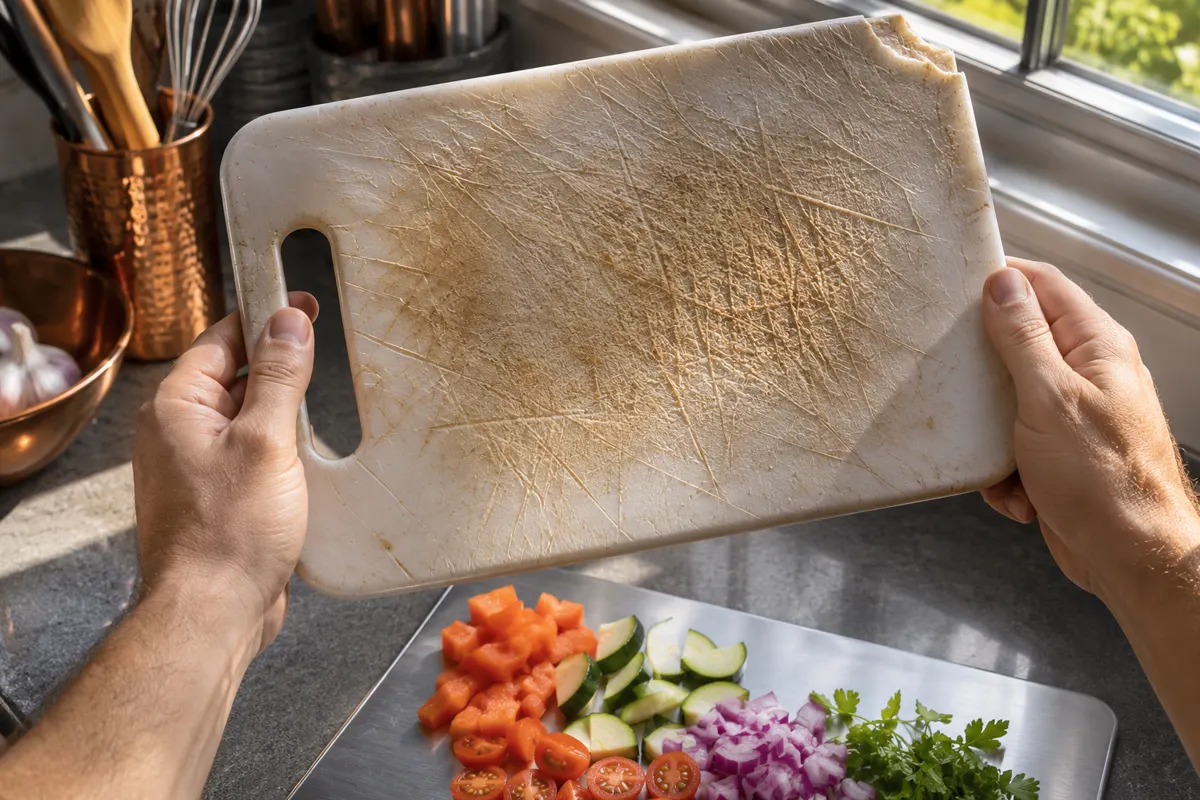
“A cutting board is scratched and chipped. What should the food handler do?” It is a classic food-safety exam question, and more and more home cooks are asking it about their own kitchens. The honest answer depends on how far the wear has gone. A few faint knife marks are just a board doing its job. Deep grooves that stay brown after washing, a chipped corner or a crack along the edge are a different story. Below we break the life of a cutting board into four stages, with how to recognize each one, what helps at that point and when it is time to let it go.
The 4 stages at a glance
| Stage | How it looks and feels | Still safe for food? | What to do |
|---|---|---|---|
| 1. Light marks | Fine surface scratches; smooth to the touch; washes clean | Yes | Wash, sanitize and dry after every use |
| 2. Deep grooves | Fingernail catches in cuts; stains or smells survive washing | Only with extra care, short term | Resurface wood; plan to replace plastic |
| 3. Chips and cracks | Missing pieces, cracked edges, splits, warping | No | Take it out of service |
| 4. Cannot be cleaned | Permanent stains, lingering odor, fuzzy or rough surface | No | Discard and replace |
Stage 1: light surface marks
How to recognize it: faint, shallow scratches you can see in the light but barely feel. The board still washes clean, has no stains and smells of nothing.
What helps: this is normal wear, and the routine is simple. Wash with hot, soapy water after every use, sanitize after raw meat, poultry or seafood and let it dry standing up. Our step-by-step on how to clean a cutting board after raw meat includes the USDA sanitizing ratio. Slicing with a gliding stroke instead of hacking straight down also slows the march toward stage 2.
Stage 2: deep grooves that hold on to things
How to recognize it: your fingernail catches in the cuts, the center of the board is visibly lower or rougher than the edges, and stains from beets or turmeric, or the smell of garlic and fish, are still there after a good wash.
Why it matters: grooves trap moisture and food residue where a sponge cannot reach. The USDA’s food safety guidance says that once cutting boards become excessively worn or develop hard-to-clean grooves, they should be replaced.
What helps at this stage:
- Wood and bamboo: sand the surface smooth with fine sandpaper, wash, dry fully and re-oil with food-grade mineral oil. This can buy a good wooden board years.
- Plastic: resurfacing at home is hard to do evenly and creates plastic dust. Treat a deeply grooved plastic board as a board on borrowed time, and use our guide on removing smells and stains from a cutting board only as a stopgap.
- Any board: keep it away from raw meat while you plan the replacement.
Stage 3: chips, cracks and warping
How to recognize it: a chunk missing from a corner, a crack running in from the edge, a split along the glue line of a wooden board, or a board that rocks on the counter because it has warped.
What the rules say: the FDA Food Code, the model code most US states use for restaurants, says cutting surfaces subject to scratching and scoring must be resurfaced if they can no longer be effectively cleaned and sanitized, or discarded if they cannot be resurfaced. A chip or crack is exactly the kind of damage that cannot be resurfaced away. Chipped plastic can also shed loose pieces into food, and a warped board is unstable under a knife, which is a cut risk of its own.
What to do: take it out of food prep. A home kitchen is not an inspected restaurant, but the logic behind the rule is the same at home.

Stage 4: a board that cannot be cleaned anymore
How to recognize it: dark, permanent discoloration in the cut zone, a smell that comes back the moment the board gets wet, a rough or fuzzy surface, or mold spots on wood.
What to do: discard it. At this point no amount of scrubbing reliably reaches the bottom of the damage. Our guide to how often to replace a cutting board lists typical lifespans by material, and how many cutting boards you need helps you rebuild a simple setup.
How long does each material take to move through the stages?
There is no official clock, because it depends on how often you cook and how you cut. In general, soft plastic boards scar fastest and cannot be refinished at home; hardwood moves more slowly and can be sanded back to stage 1 more than once; glass and stone resist scratches but are hard on knives and can chip. A solid metal board sits in a different place: it is non-porous, so marks on its surface do not soak up juices or odors, and it does not shed plastic particles as it is used. Our guide to the best cutting board material compares them side by side.
Our recommendation: the Katori titanium cutting board
If your board is already at stage 3 or 4, or a plastic one is sliding into stage 2, this is the moment to replace it with something that stays at stage 1 far longer. The Katori titanium cutting board is the option we recommend. It breaks the cycle that sends people shopping for a new board every year or two: no absorbent grooves to trap residue, no plastic to shed into food, and a surface that goes straight into the dishwasher.
- 100% titanium, per the maker: no coating to wear through and no plastic side to score.
- Non-porous surface: juices, smells and stains stay on top and wash away.
- Laser-cut, double-sided: one face for raw meat and one for produce, so cross-contamination is easier to avoid.
- Zero microplastics: nothing shed into your food as you cut.
- Dishwasher-proof: no warping, cracking or oiling. Size 11.4" x 7.9".
- 30-day money-back guarantee: refund or exchange, with 24/7 support from the official store.
On the official store a single board is currently $59.00 (50% off), the 2-board set is $99.98, three boards are $137.85 and four are $143.60. Shipping is calculated at checkout. The board is rated 4.7/5 by more than 1,894 reviewers. For the full picture, read our hands-on Katori review or see the Katori overview.
Scratched cutting board FAQ
A cutting board is scratched and chipped. What should the food handler do?
Stop using it for food. Under the FDA Food Code, cutting boards that are subject to scratching and scoring must be resurfaced if they can no longer be effectively cleaned and sanitized, or discarded if they cannot be resurfaced. A chipped board is usually a discard, because chips and deep gouges cannot be reliably cleaned and loose pieces can end up in food.
Is it safe to use a scratched cutting board?
Light surface marks are normal and a board with only shallow scratches is fine if you wash and sanitize it properly. Once grooves are deep enough to catch a fingernail, hold stains or smell after washing, the USDA advises replacing the board because those grooves are hard to clean.
Can you sand a scratched plastic cutting board?
Commercial kitchens sometimes resurface thick plastic boards with special tools, but sanding plastic at home is hard to do evenly and creates plastic dust. For most home cooks, a deeply scored plastic board is a replace-it board.
How do you fix a scratched wooden cutting board?
Shallow knife marks on wood can be sanded smooth with fine sandpaper, washed, dried and re-oiled with food-grade mineral oil. Cracks that go through the board or split along the glue lines cannot be sanded away, and the board should be replaced.
Does a titanium cutting board get scratched?
Any surface shows marks with use, but a solid metal board does not develop the deep, absorbent grooves that plastic does. It is non-porous, so marks do not soak up juices, and it can be washed in the dishwasher.
Want the whole picture? Our complete cutting board guide maps every topic, from materials to microplastics. Food-safety rules for restaurants are set by your state and local health department; this article is general information for home cooks.