Quick answer
Give every person in the kitchen a clear job and a clear surface. Little kids work on soft foods with a kid-safe knife, older kids move up to a small knife and harder produce with an adult beside them, and the adults agree on a few rules: one board side for raw meat, one for produce and bread, knives carried and stored by grown-ups, and clean as you go. A steady, double-sided board like the Katori titanium cutting board makes that two-zone rule easy for everyone.
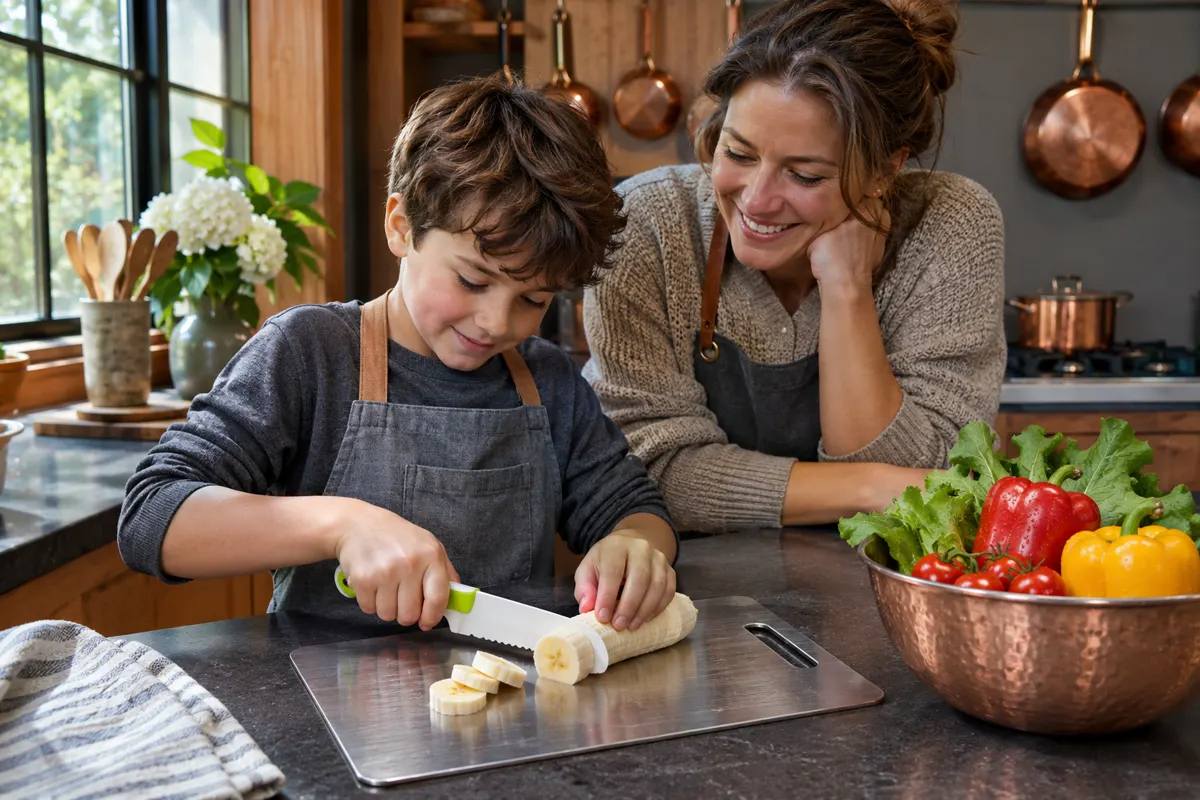
Cooking together sounds lovely until three people reach for the same board, someone slices bread on the surface that just held raw chicken, and a five-year-old wants the big knife. None of that means you should cook alone. It means the kitchen needs the same thing any team needs: roles, a shared language and the right tools. This guide is about partnership, not about taking over: how couples split the work without stepping on each other, and how kids of every age can genuinely help at the cutting board.
Why a shared kitchen needs a few rules
Most kitchen slips in a busy household come from good intentions. A partner helpfully rinses the knife you used on raw turkey and starts on the salad. A child puts washed strawberries on the board you just used for burgers. Food-safety agencies such as the USDA keep the advice simple: clean, separate, cook and chill. The “separate” part, keeping raw meat, poultry and seafood away from ready-to-eat food, is the one that breaks most easily when several people share the same counter. A few agreed rules fix it.
The five house rules for cooking together
- One side for raw, one side for ready-to-eatDecide once which board, or which side of a double-sided board, is for raw meat, poultry and seafood, and which is for produce, bread and cheese. Say it out loud so everyone knows.
- Grown-ups carry and store the knivesKids use the knife they are given, at the board, and hand it back. Knives never go into a sink full of soapy water where nobody can see them.
- Wash hands at every switchBefore cooking, after handling raw meat or eggs, and after a trip to the bathroom or the dog. Twenty seconds with soap and water.
- Clean as you goWash the board and knife as soon as the raw part is done, before anyone uses them for anything else. Our guide to cleaning a cutting board after raw meat shows the steps.
- One leader per mealThe leader decides the order and hands out jobs. Next meal, swap. It removes most of the “that is not how I do it” moments.
Cutting board jobs by age
Every child is different, so treat ages as rough guides and go by focus and coordination. Cooking-with-kids guides from extension programs and cooking schools follow a similar path: soft foods and dull knives first, real knives and harder foods later, always with an adult close by.
| Age (approx.) | Good jobs at the board | Tool |
|---|---|---|
| 2–3 | Tearing lettuce and herbs, washing produce in a bowl, placing items on the board | Hands only |
| 3–5 | Slicing bananas, strawberries, soft cheese, cooked potatoes; spreading | Plastic or butter knife |
| 6–8 | Cucumbers, mushrooms, soft fruit, herbs; the “claw” grip | Kid-safe or small knife, adult beside them |
| 8–12 | Carrots, celery, peppers, onions; simple recipes start to finish | Small real knife, close supervision |
| Teens | Full prep, raw meat with hand-washing rules, leading a meal | Regular kitchen knives |
Teaching the two grips that matter
Two habits make knife work safer at any age. The claw: the hand holding the food curls its fingertips under, knuckles forward, so the blade meets knuckles, not fingertips. The bridge: for round foods like tomatoes or apples, the hand forms an arch over the food and the knife goes under the arch. Practice both on a banana before moving on to anything firmer, and cut round foods in half first so they sit flat.
Set the board up so it cannot slide
A board that wobbles is the most common reason a beginner slips. Put a damp towel or a non-slip mat under it, work at a height where the child’s elbows are above the counter (a sturdy step stool helps), and keep the board clear of clutter so there is always room to work.

For couples: splitting the work without the friction
- Stations, not sharing — one person at the board, one at the stove. Two boards if you both need to cut at once.
- Agree on the raw-meat plan — which board, which knife, and who washes it right after. Decide it once, not every night.
- Prep together on Sunday — one chops, one stores, and weeknight dinners take half the time. Our 1-hour Sunday chopping routine works well as a team.
- Respect each other’s tools — if one of you cares about sharp knives, a board that is gentle on edges keeps the peace. More on that in how to keep knives sharp.
- Swap the leader role — the cook decides, the helper helps. Tomorrow, switch.
How many boards does a family need?
For most households, two is the comfortable minimum once more than one person cooks: one for raw meat, poultry and seafood, one for produce and bread, or a double-sided board plus a second for busy nights. Our guide on how many cutting boards you need covers the normal setup in more detail, and it is worth checking your current boards against the signs in when to replace a cutting board: deep grooves are hard to clean and easy for little knives to catch on.
Why a titanium board suits a family kitchen
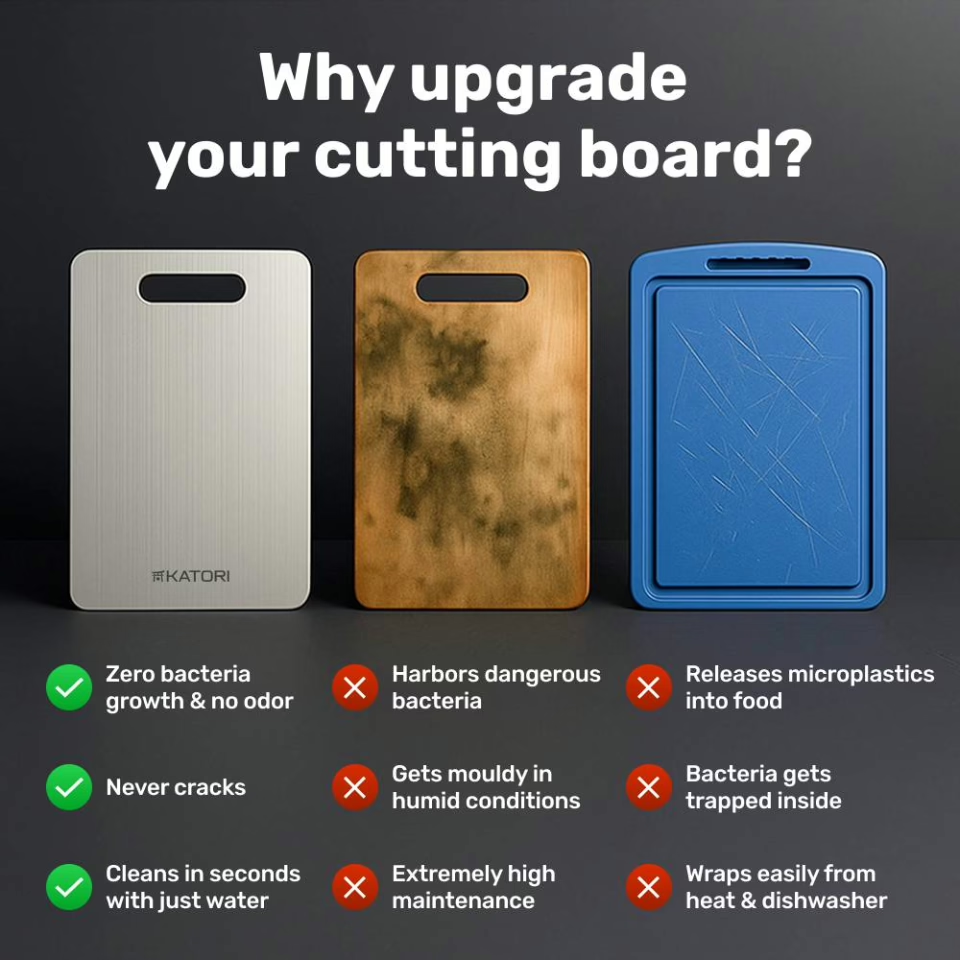
A family board takes a beating: little hands, enthusiastic sawing, juice everywhere, and daily trips through the dishwasher. The Katori 100% titanium cutting board handles that well. It is non-porous, so juices and smells stay on the surface and wash away; it is double-sided, so “this side for raw, that side for fruit” is a rule even a six-year-old can follow; and it goes in the dishwasher without warping or cracking, so cleaning as you go is quick.
Our recommendation: the Katori titanium cutting board
If your kitchen is turning into a team kitchen, the Katori 100% titanium cutting board is the one we recommend. It is the simplest way to give a busy household a clean, steady, clearly divided prep surface, and many families take the 2-board set so the adults and the kids can each have their own station.
- Double-sided: one face for raw meat and fish, the other for produce and bread, an easy rule for the whole family.
- Non-porous 100% titanium: juices, smells and stains stay on the surface and wash away.
- Zero microplastics: no plastic shavings ending up in the kids’ food.
- Dishwasher-proof: no warping, cracking or oiling, so cleaning as you go takes seconds.
- Laser-cut surface: designed by the maker to help knives keep their edge.
- Handy size: 11.4" x 7.9", right for a small workstation or a child at the counter.
On the official store a single board is currently $59.00 (50% off), the best-selling 2-board set is $99.98 ($49.99 each), the 3-board set is $137.85 ($45.95 each) and the 4-board set is $143.60 ($35.90 each). Shipping is calculated at checkout. Every order is backed by a 30-day money-back guarantee, and the board is rated 4.7/5 by more than 1,894 reviewers.
Cooking with kids and your partner: FAQ
At what age can a child use a knife on a cutting board?
Many cooking-with-kids guides start preschoolers on soft foods such as bananas and strawberries with a plastic or butter knife, move to a small paring knife and soft produce around ages 6 to 8 once they show control, and introduce harder vegetables like carrots from about 8 to 12. Ages are only rough guides: go by your own child's focus and coordination, and always supervise.
Can kids help with raw meat?
Young children are better kept on the produce and bread side. Older kids can help with raw meat when an adult is right there and they wash their hands with soap and water before and after. Keep raw meat, poultry and seafood on their own board and never let them touch ready-to-eat food.
How do couples share a kitchen without arguing?
Agree on a few shared rules once: which board is for raw meat and which is for produce, where the knives live, who cleans as they go, and who leads each meal. Giving each person a clear station and job usually removes most of the friction.
What kind of cutting board is best for cooking with kids?
A board that stays flat and steady, is easy to clean thoroughly and has a clear raw side and produce side. Put a damp towel under any board so it cannot slide. A non-porous, double-sided board like the Katori titanium board makes the two-zone rule easy for the whole family.
What knife should a beginner child use?
Start with a plastic or nylon kid-safe knife or a butter knife on soft foods. Move to a small, real knife only when the child grips well, keeps the other hand in a claw shape and stays focused, and always with an adult next to them.
Want to keep learning? Read Thanksgiving cutting board rules, see what to do if you used the same board for raw chicken and vegetables, head back to the Katori overview or read our hands-on Katori review.